
Leucine in Foods: Why It's the Key to Muscle After 40
TL;DR
- Leucine, not total protein, is the amino acid that triggers muscle protein synthesis—aim for 3g of leucine per meal, not just daily totals.
- Women over 40 need roughly 1g of protein per pound of body weight daily , distributed across meals with 35–40g and 3g leucine per main meal.
- Animal proteins (whey, tuna, chicken, beef) deliver leucine most efficiently; plant proteins require larger portions or strategic combining to hit the 3g threshold.
- Greek yogurt alone won't reach your leucine target—pair it with cottage cheese, eggs, hemp seeds, or whey protein to close the gap.
- Use a protein tracker for 2–4 weeks to build familiarity with your key sources, then step back; you don't need to track indefinitely once you know the numbers.

What Is Leucine?
Leucine is an essential amino acid — one of the three branched-chain amino acids (BCAAs) — and it's the one that triggers muscle protein synthesis. Knowing the leucine content in foods is more useful than tracking protein grams alone, especially if you're over 40 and want to stay strong.
For most readers, this is practical nutrition: leucine is found in varying amounts across meats, dairy, legumes, and plant proteins, and hitting a meaningful amount per meal matters more than daily totals alone. For women in their 40s and beyond, that bar is higher than general guidelines suggest. The RDA of 0.8g of protein per kilogram of body weight is designed to prevent deficiency — not to support an active body dealing with shifting hormones and reduced anabolic sensitivity.
Dr. Stacy Sims's research-backed protocol sets the target at roughly 2.2g of protein per kilogram of body weight daily — simplified as about 1g per pound — with each main meal delivering at least 35–40g of protein and 3g of leucine. That leucine threshold is the point at which muscle protein synthesis is reliably stimulated in older women, a finding supported by peer-reviewed research including work published in the Journal of Nutrition (Churchward-Venne et al., 2012) on leucine supplementation and anabolic response.
What follows is a breakdown of which foods actually deliver that leucine, with specific amounts per serving, so you can build meals that work — not just meals that feel healthy.
Why Leucine Is Your Muscle-Building Ally After 40

After 40, your muscles become less responsive to the protein you eat — a process called anabolic resistance. You need a stronger signal to trigger muscle repair and growth, and leucine is what delivers it. In short, leucine is your strongest defense against muscle loss after 40.
Of all the amino acids, leucine directly activates mTOR, the pathway that switches on muscle protein synthesis. Without enough leucine in a meal, that signal stays too weak to meaningfully stimulate repair — regardless of how much total protein you ate that day. A 2019 review in Nutrients found that leucine supplementation significantly improved muscle protein synthesis responses in older adults, particularly when doses reached the 3g-per-meal threshold.
The Threshold That Matters
Hitting the 3g leucine threshold per meal, anchored within 35–40g of protein, is a higher bar than general guidelines suggest — and deliberately so.
Knowing the leucine content in foods makes hitting that threshold straightforward. A 170g serving of canned tuna delivers roughly 3.2g of leucine. A 30g scoop of whey protein concentrate provides approximately 2.6g. A 200g chicken breast reaches around 3.5g. Animal proteins tend to be the most efficient sources — plant proteins generally require larger portions to reach the same leucine dose.
The practical shift is small: instead of counting total daily protein alone, build each meal around a source you know clears the 3g mark.
Understanding the Leucine Threshold for Muscle Health
The leucine threshold is simple: your muscles need a minimum of 3 grams of leucine in a single meal to trigger meaningful muscle protein synthesis. Fall short of that, and the signal to rebuild never fully fires — even if you ate protein.
For women over 40, hitting that threshold consistently matters more than total daily protein alone. A day where breakfast is light, lunch is heavy, and dinner is moderate might clear the threshold only once. That's one rebuilding signal in a day that needed three.
A 2021 review in Nutrients confirmed that older adults require both higher leucine concentrations per meal and more frequent stimulation of muscle protein synthesis compared to younger adults — making meal distribution a specific concern, not a general preference.
In practice, the per-meal target of 35–40g of high-quality protein will reliably deliver 3g of leucine, provided the protein source is high-quality.
A small yogurt at breakfast — often only 10–12g of protein and under 1g of leucine — doesn't get close. Swapping to cottage cheese with eggs, or adding a quality whey protein to a smoothie, changes the math immediately. That's the practical value of understanding these numbers: you stop guessing and start building meals that actually work.
How Much Leucine Do You Need Per Day?
Leucine's bare-minimum RDA is only about 2.7g a day (roughly 39mg per kilogram of body weight) — enough to prevent deficiency, but far short of what protects muscle after 40. A muscle-supporting intake lands closer to 9–12g a day — which is simply what you get by hitting ~3g of leucine at each of three to four protein-rich meals.
How Much Leucine Is in Common Foods?
Not all protein foods deliver leucine equally. Whether you're optimizing meals for muscle maintenance or simply trying to understand leucine content in foods before narrowing down what works for your body, the table below gives you a concrete starting point. The 3g-per-meal target applies regardless of whether your protein comes from animals or plants.
Animal-Based Sources
Animal proteins are the most direct route to 3g of leucine per meal. Here's how the most common options compare:
| Food | Serving | Protein (g) | Leucine (g) |
|---|---|---|---|
| Chicken breast (cooked) | 5 oz | ~40g | ~3.2g |
| Lean beef, 90/10 (cooked) | 5 oz | ~38g | ~3.0g |
| Salmon (cooked) | 5 oz | ~34g | ~2.7g |
| Whey protein (concentrate) | 1 scoop (~30g) | ~24g | ~2.6g |
| Tuna, canned in water | 5 oz | ~33g | ~2.6g |
| Cottage cheese, 2% | 1 cup | ~24g | ~2.3g |
| Greek yogurt, 0% | 1 cup | ~22g | ~2.1g |
| Sardines, canned | 1 tin (~3.75 oz) | ~22g | ~1.8g |
| Eggs | 3 large | ~18g | ~1.5g |
| Milk | 1 cup | ~8g | ~0.8g |
Sources: USDA FoodData Central; manufacturer values for whey concentrate.
A serving of whey or tuna gets you to the 3g threshold with little effort, which is why they're frequently recommended as anchors for the per-meal target.
Plant-Based Sources
Plant foods can get you there, but portions matter more. Soy is the standout — tofu, tempeh, and edamame have both higher leucine density and a complete amino acid profile compared to most legumes.
| Food | Serving | Protein (g) | Leucine (g) |
|---|---|---|---|
| Tempeh | 1 cup (166g) | ~31g | ~2.4g |
| Edamame, shelled | 1 cup | ~22g | ~1.9g |
| Firm tofu | 1 cup (252g) | ~20g | ~1.8g |
| Lentils, cooked | 1 cup | ~18g | ~1.3g |
| Black beans, cooked | 1 cup | ~15g | ~1.1g |
| Pumpkin seeds | 1/4 cup (32g) | ~10g | ~0.8g |
| Quinoa, cooked | 1 cup | ~8g | ~0.5g |
A cup of lentils paired with tempeh and pumpkin seeds can reach 3g leucine and well above 35g total protein. For fully plant-based diets, add 15% to your daily protein target to account for the lower digestibility of plant proteins. Research published in Nutrients (Gorissen et al., 2018) confirms that leucine levels in plant protein sources are consistently lower than in animal proteins, reinforcing the case for larger portions or strategic combining rather than simple food swaps.
Building Leucine-Rich Meals and Smart Swaps
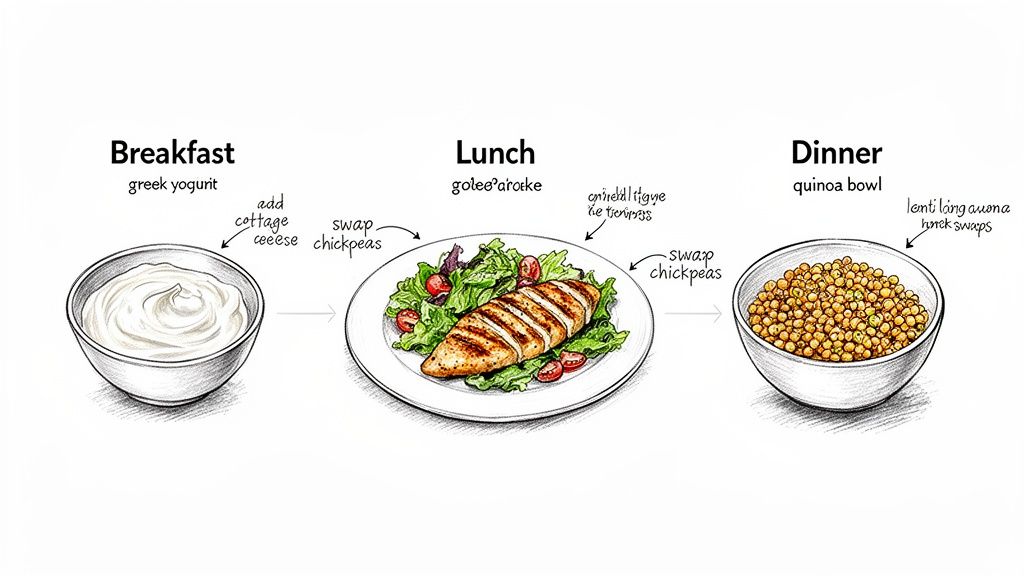
The practical side of hitting 35–40g protein and 3g leucine per meal comes down to choosing the right foods and knowing where to add density without overhauling your entire plate.
Sample Omnivore Meal Ideas
Breakfast: 1 cup plain Greek yogurt topped with a tablespoon of hemp seeds and a small handful of almonds. Greek yogurt alone delivers roughly 17g protein and 1.5g leucine — the seeds push you closer to threshold.
Lunch: A 5-oz grilled chicken breast over mixed greens with a quarter cup of chickpeas and vegetables. Chicken breast provides approximately 3.2g leucine per 5oz serving, making it one of the more efficient sources at a standard meal portion.
Dinner: 5oz baked salmon with 1 cup quinoa and roasted broccoli. Salmon contributes around 2.7g leucine per 5oz, with quinoa adding a small but meaningful top-up.
Smart Plant-Based Meal Combinations
Plant-based eaters should apply the +15% daily target adjustment, since plant proteins are less leucine-dense and less bioavailable than animal sources.
Breakfast: 1 cup firm tofu scrambled with spinach and nutritional yeast (~18g protein, ~1.6g leucine). Add 2 tablespoons of pumpkin seeds to close the gap.
Lunch/Dinner: 1 cup cooked lentils combined with 1 cup cooked quinoa and 100g tempeh. This combination reaches roughly 38g protein and approaches the 3g leucine threshold — one of the more reliable plant-forward meals for doing so.
Easy Upgrades and Smart Swaps
Small additions move the needle more than full meal overhauls. A few high-impact options:
- Smoothies: Add half a cup of cottage cheese or a scoop of quality whey protein. Whey delivers roughly 2.6g leucine per 30g scoop, placing it consistently at the top of per-serving rankings in the research literature.
- Salads: A 3oz can of tuna adds approximately 1.4g leucine. Two hard-boiled eggs contribute around 1g. Stack both and your salad becomes a complete protein meal.
- Oatmeal: Stir in hemp seeds (3 tablespoons add ~10g protein) or mix in Greek yogurt after cooking for a thicker, higher-protein base.
- Snacks: Roasted edamame, a small container of Greek yogurt, or a boiled egg contribute meaningfully to daily totals without requiring a full meal.
Consistency matters more than precision. A meal that falls slightly short does not erase progress — it is simply the next chance to hit your target.
How Dairy and Protein Powders Can Boost Your Intake
Whole-food meals should anchor your protein intake, but dairy and protein powders are practical tools for days when time is short or meals come up light.
Dairy
Greek yogurt, cottage cheese, and milk are among the more concentrated sources when you look at leucine content in foods broadly — and they require almost no preparation. A cup of cottage cheese delivers roughly 2.5–3g of leucine on its own. Add a hard-boiled egg or a small serving of meat and you've met the per-meal target. A 2019 study published in Nutrients (Deer & Volpi) confirmed that leucine-rich dairy proteins are particularly effective at overcoming anabolic resistance — making them a practical choice for women over 40, not just a convenient one.
Protein Powders
Whey isolate is the most leucine-dense powder option, typically providing 2.5–3g of leucine per 25g scoop. Casein is slower-digesting and works well before sleep. For plant-based eaters, a pea/rice blend or soy protein can match whey's leucine profile — just increase the serving size by about 15% to account for lower bioavailability.
The most useful applications are post-workout recovery, fortifying a carb-heavy breakfast, and closing a gap on days when meals run low on protein. Use them where they fit — they're not a substitute for whole foods, but they make consistency easier.
Common Questions About Leucine and Protein for Women
Do I Need a Leucine Supplement?
For most women, no — you can hit your leucine targets with everyday foods (see the lists above). Isolated L-leucine or BCAA powders (often sold in 1,000mg+ servings) can help in specific situations: a small appetite, a plant-based diet that struggles to reach 3g per meal, or a quick boost around training. But whole foods deliver the complete protein package, so the rule stays simple: food first, and reach for a supplement only to fill a gap.
You may also see leucine paired with velositol, a patented complex studied to further amplify leucine's muscle-building signal. Interesting — but not necessary. The foundation is simply hitting your leucine threshold from real food.
Do I Really Need to Track Leucine Every Day?
No — not indefinitely. The goal is to build enough familiarity with your key protein sources that tracking becomes unnecessary. Once you know that 5oz of chicken breast delivers roughly 3.2g of leucine, or that 1.5 scoops of whey protein gets you to 3g, you stop needing an app to confirm what you already know. Use a tracker for two to four weeks to calibrate your intuition, then step back.
Is It Possible to Have Too Much Leucine?
From whole foods, it's unlikely to be a problem for healthy women. Some research, including a 2017 review in the Journal of the International Society of Sports Nutrition (Stokes et al.), notes that extremely high leucine supplementation may overstimulate mTOR pathways in ways not yet fully understood — but this is specific to concentrated isolated supplements, not food. Spread your protein across meals rather than loading it all into one sitting.
When Should I Eat a High-Leucine Meal?
Three moments matter most:
- Breakfast: Muscle protein synthesis drops overnight. A leucine-sufficient breakfast restores it early.
- Post-resistance training: Muscles are most receptive within two hours of a workout. Prioritize your highest-quality protein source here.
- Evenly distributed across meals: Per this protocol, spreading intake across two to three meals — rather than backloading — is more effective for muscle maintenance in women over 40.
How Can I Meet My Needs on a Vegan Diet?
Plant-based eating requires deliberate combining. Individual plant sources are lower in leucine than animal proteins, so add 15% to your daily target to compensate. Practical combinations that reach the 3g threshold per meal:
- Lentils + quinoa: 1 cup each, cooked
- Tofu + hemp seeds: 1 cup firm tofu with 3 tablespoons hemp seeds
- Tempeh + edamame: 4oz tempeh alongside 1 cup shelled edamame
- Soy protein powder + nut butter: in a smoothie or oatmeal
Soy is the most leucine-dense plant source available — center plant-based meals around it when possible.
New to this? Start with how much protein women over 40 actually need.
Frequently Asked Questions
Why is leucine more important than total daily protein?
Leucine directly activates mTOR, the metabolic pathway that switches on muscle protein synthesis. After 40, your muscles become less responsive to protein signals overall—you need a stronger, more frequent trigger. A meal with 50g of protein but only 2g of leucine won't stimulate muscle repair the way 35g of protein with 3g of leucine will. The threshold matters more than the daily total because muscle protein synthesis is triggered per meal, not accumulated daily.
Can I reach the 3g leucine target on a fully plant-based diet?
Yes, but it requires deliberate combining and a +15% adjustment to your daily protein target. Soy-based foods (tempeh, tofu, edamame) are your most leucine-dense plant options. A practical meal combining 1 cup cooked lentils, 1 cup cooked quinoa, and 100g tempeh reaches roughly 38g protein and approaches the 3g leucine threshold. Individual plant sources are lower in leucine than animal proteins, so centering meals around soy and pairing complementary sources is essential.
What's the difference between whey isolate and whey concentrate for leucine content?
Both deliver similar leucine per serving—roughly 2.5–3g per 25–30g scoop—but isolate is more processed and contains less lactose, making it gentler for sensitive digestion. Concentrate is slightly less expensive and includes more of the whole whey profile, including immune-supporting compounds. For leucine content specifically, choose based on your digestion and budget; the leucine dose is comparable between the two.
Should I eat my highest-protein meal before or after a workout?
Post-workout is ideal—muscles are most receptive to protein signaling within two hours of resistance training, making it the highest-impact time to deliver your 35–40g protein and 3g leucine target. However, consistency across all three main meals matters more than optimizing one meal. If a post-workout meal doesn't fit your schedule, prioritize hitting the threshold evenly across breakfast, lunch, and dinner instead.
Can I get too much leucine from whole foods?
From whole foods alone, no—it's extremely unlikely to be problematic for healthy women. Concerns about excessive leucine stimulation arise only with concentrated isolated supplements at very high doses. Whole-food protein sources contain leucine in balance with other amino acids, making them inherently safe. Spread your protein across two to three meals per day rather than loading it all into one sitting for optimal muscle protein synthesis signaling.
This article is for education only and is not medical advice. Just Protein is not a medical provider — we summarize published research and cite our sources so you can verify them; decisions about your health, hormones, or mood belong with your doctor.
