
TL;DR
- Perimenopause belly fat is hormonal, not a willpower problem—declining estrogen shifts fat storage to your abdomen while accelerating muscle loss.
- Aim for ~1g of protein per pound of body weight daily, spread across meals with 35–40g of high-leucine protein per meal to overcome anabolic resistance.
- Resistance training 2–3 times per week is more effective than cardio alone for addressing perimenopause belly fat and rebuilding metabolic capacity.
- Not all protein sources are equal: collagen and protein bars fall short of the 3g leucine threshold needed to trigger muscle protein synthesis in women over 40.
- Sleep (7–9 hours) and stress management directly lower cortisol and reduce abdominal fat accumulation—these are non-negotiable alongside diet and training.
If you're over 40 and noticing stubborn fat accumulating around your midsection, you're experiencing one of the most common—and least discussed—symptoms of perimenopause. Perimenopause belly fat isn't a willpower problem. It's a hormonal one. As estrogen and progesterone shift, your body redistributes fat toward the abdomen and becomes less efficient at building and preserving muscle.
The good news: this process is not inevitable. Research, including work by exercise physiologist Dr. Stacy Sims, shows that women over 40 who prioritize resistance training and adequate protein can meaningfully change their body composition—even during perimenopause.
This guide covers the science behind these changes and gives you a practical, evidence-based plan. The core strategy centers on building muscle through strength training and hitting a daily protein target of approximately 2.2g per kilogram of body weight—roughly 1g per pound—as recommended by Dr. Stacy Sims. That's well above the standard RDA of 0.8g/kg, which was designed to prevent deficiency, not support an active body going through hormonal change.
Why This Matters for Women Over 40
Perimenopause belly fat is one of the most common and frustrating changes women experience in their 40s and 50s — and it's not a willpower problem. It's a direct result of shifting internal chemistry.
As estrogen declines, your body changes where it stores fat. Instead of hips and thighs, excess fat migrates to the abdomen, particularly as visceral fat around the organs. At the same time, declining estrogen accelerates muscle loss (sarcopenia), and cells become less responsive to insulin — making it easier to store blood sugar as abdominal fat rather than burn it as fuel. Elevated cortisol from poor sleep or chronic stress adds another layer, triggering cravings and compounding midsection storage.
| Factor | What Changes | Impact on Belly Fat |
|---|---|---|
| Estrogen | Declines and becomes erratic | Shifts fat storage to the abdomen |
| Muscle Mass | Decreases (sarcopenia) | Lowers resting metabolic rate |
| Insulin Sensitivity | Cells become less responsive | Promotes visceral fat storage |
| Cortisol | Rises with stress and sleep disruption | Drives cravings and midsection fat |
This isn't just an aesthetic issue. Visceral fat is metabolically active tissue linked to insulin resistance, cardiovascular risk, and inflammation — and it climbs sharply through menopause as estrogen falls, rising from roughly 5–8% of body fat before menopause to 15–20% after (menopause & body-composition review, 2022). For women over 40, addressing perimenopause belly fat is about protecting long-term metabolic health — not just how your clothes fit.
These interconnected factors explain why the standard advice — eat less, move more — stops working. A strategy that directly targets muscle preservation and hormonal metabolism is what this life stage actually requires.
The Simple Science (Explained Clearly)
To understand perimenopause belly fat, you need to look at two hormonal shifts happening simultaneously.
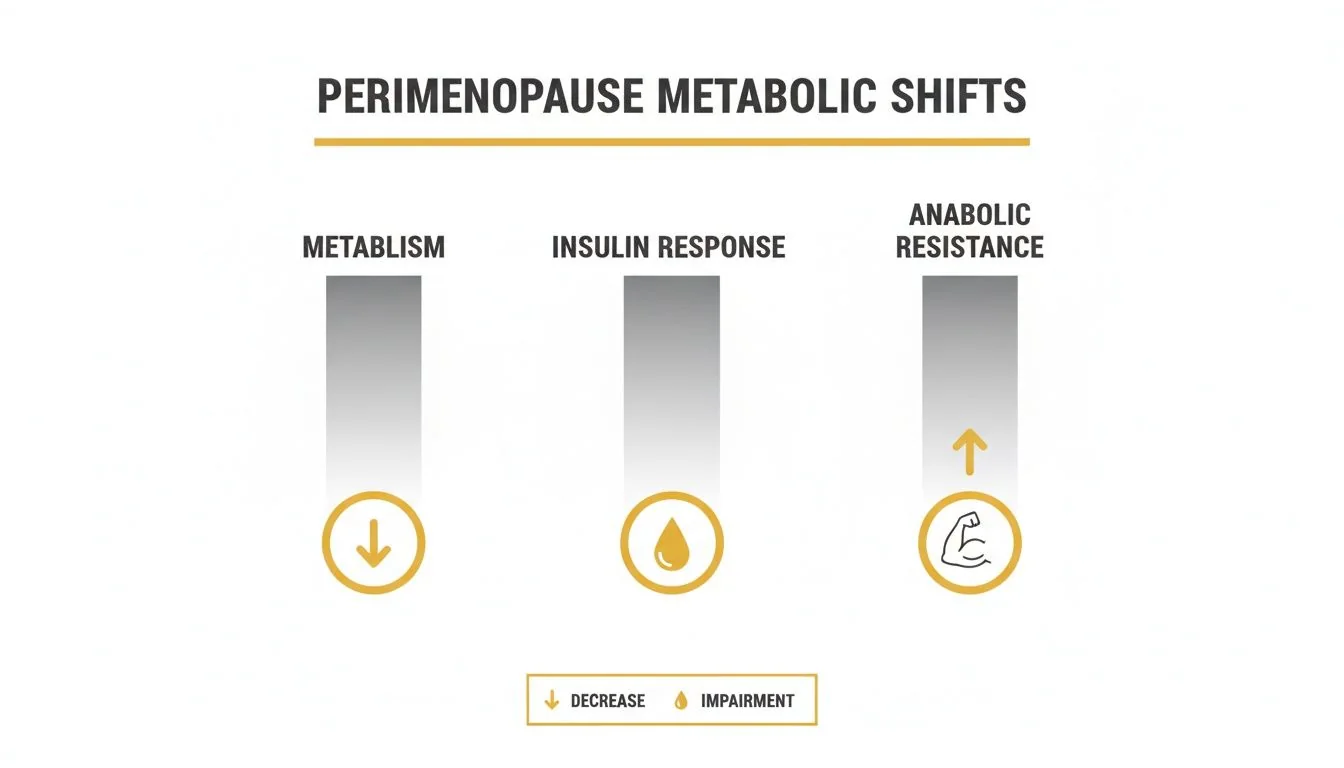
As estrogen declines, it changes where your body stores fat — steering it to your abdomen instead of your hips and thighs. (Importantly, this isn't your metabolism slowing down: research shows your metabolic rate stays remarkably steady through midlife.) At the same time, your cells become less responsive to insulin. When that "key" doesn't work as well, excess glucose gets routed to fat storage, and the preferred address is visceral fat around your midsection. This is insulin resistance, and it's why refined carbs that were harmless in your 30s can feel like they go straight to your belly now.
The Insulin Connection
Insulin resistance doesn't require a diabetes diagnosis to affect body composition. Even mild resistance — well within the "normal" range — shifts your body toward fat storage and away from fat burning. Reducing refined carbohydrates and increasing protein at each meal are two of the most direct levers for improving insulin sensitivity.
Introducing anabolic resistance
The second shift is anabolic resistance: your muscles require a stronger stimulus to rebuild after a meal or workout. The protein amount that maintained muscle in your 30s no longer clears the threshold.
This matters because muscle is your most metabolically active tissue. Less muscle means a lower resting metabolic rate — and because muscle is your most metabolically active tissue, that muscle loss (not a slowdown in metabolism itself) is what quietly lowers your daily burn.
The practical implication is specific: per-meal protein targets matter more than total daily intake alone. Research from Dr. Stacy Sims points to 35–40g of protein per meal, with at least 3g of leucine, to overcome anabolic resistance in women over 40 — significantly above the RDA of 0.8g/kg, which was designed to prevent deficiency, not support an active body (PROT-AGE position paper, 2013).
Common Myths vs. Protein Truth
The old-school advice of "eat less, move more" misses the real problem during perimenopause: muscle loss driven by hormonal shifts. More protein — the right protein — is what changes the outcome.
Myth 1: "A gram of protein is a gram of protein."
Not all protein sources deliver enough leucine — the amino acid that actually triggers muscle repair. Collagen powder is a common example: a 30g serving provides roughly 30g of protein but only ~0.7g of leucine. That falls far short of the 3g leucine threshold needed per meal to stimulate muscle protein synthesis in women over 40.
The fix: Choose high-leucine sources — whey protein isolate, chicken, Greek yogurt, or firm tofu — as your protein anchor at each meal.
Myth 2: "A high-protein snack bar is a solid meal replacement."
Many "protein" products look impressive on the label but don't hold up. A popular protein cookie might list 15g of protein alongside 400 calories — that's a 15% protein-to-calorie ratio. A chicken breast, by contrast, is over 80% protein by calories.
The fix: For perimenopause belly fat and muscle loss, protein-to-calorie ratio matters as much as the gram count. Aim for 35–40g of protein per meal from whole food sources where protein is the dominant macronutrient — not an afterthought buried under sugar and fat.
Hitting the Leucine Trigger: Real-World Examples
To meet both the 35–40g protein minimum per meal (per Dr. Stacy Sims' protocol for women over 40) and the 3g leucine threshold, here's how common sources compare:
| Protein Source | Portion for ~35g Protein | Typical Leucine (g) | Meets 3g Threshold? |
|---|---|---|---|
| Whey Protein Isolate | ~1.2 scoops (~40g) | ~3.7g | Yes |
| Chicken Breast | ~5 oz / 140g | ~3.4g | Yes |
| Greek Yogurt (Plain) | ~1.75 cups / 400g | ~3.4g | Yes |
| Firm Tofu | ~1.75 cups / 440g | ~3.0g | Yes |
| Lentils (Cooked) | ~2.3 cups / 460g | ~2.3g | No (pair with quinoa) |
| Collagen Peptides | ~3.5 scoops (~35g) | ~0.8g | No |
Plant-based eaters should increase their daily protein target by 15% to account for lower bioavailability, and pair lower-leucine sources like lentils with complementary proteins to reliably hit the threshold.
Clear, Actionable Steps You Can Take Today
Understanding the why matters, but here's the how. These four steps work with your body's shifting hormones — not against them.
Step 1: Set Your Protein Target
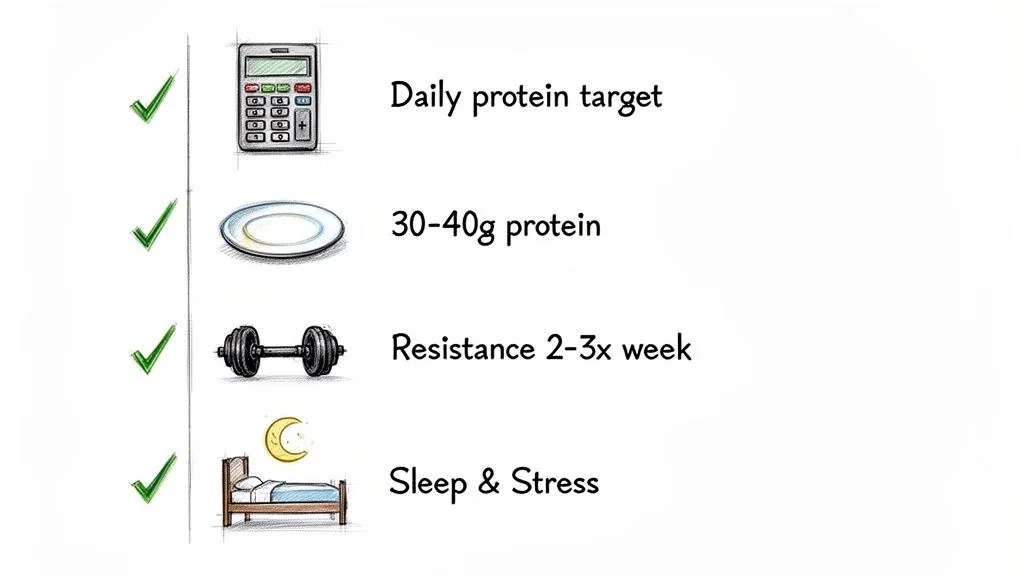
Following Dr. Stacy Sims' protocol for active women over 40, aim for ~2.2g of protein per kilogram of body weight — roughly 1g per pound. This is significantly above the RDA of 0.8g/kg, which is designed to prevent deficiency, not support a body dealing with anabolic resistance and declining estrogen.
Step 2: Anchor Meals with Enough Protein to Matter
Spread your daily target across two to three main meals, hitting 35–40g of high-quality protein per meal. This threshold — along with at least 3g of leucine — is what triggers meaningful muscle protein synthesis at this life stage. Build your plate around the protein source first, then fill in the rest. A protein tracker app can help you confirm you're consistently hitting that mark.
Step 3: Give Protein a Job with Resistance Training
Protein builds muscle only when paired with a stimulus. Two to three full-body strength sessions per week — dumbbells, bodyweight, or resistance bands — improve insulin sensitivity and raise your resting metabolism. This combination directly addresses perimenopause belly fat by shifting body composition over time.
Step 4: Protect Sleep and Manage Cortisol
- Sleep: Aim for 7–9 hours. Sleep is when hormonal repair happens — shortchanging it drives appetite dysregulation and fat storage.
- Stress: Even small interventions matter. A 10-minute walk or five minutes of intentional quiet can meaningfully lower cortisol, which is directly tied to abdominal fat accumulation.
Your Questions, Answered
Navigating perimenopause belly fat raises a lot of practical questions. Here are direct answers.
Do I Have to Give Up Carbs to Lose Belly Fat?
No. The goal is protein prioritization, not carbohydrate elimination. Pair complex carbs—quinoa, sweet potatoes, berries—with a solid protein serving. This stabilizes blood sugar and supports sustained energy without restrictive rules.
Is Cardio or Weight Training Better for Perimenopause Belly Fat?
Resistance training is your most effective tool. It directly counters the muscle loss driving metabolic slowdown. Aim for two to three full-body strength sessions per week as your foundation. Cardio—like daily walking—works well alongside it for cardiovascular health, but it won't move the needle on body composition the way lifting will.
What If I'm Not Hungry Enough to Hit 35–40g of Protein at Breakfast?
This is common. A practical fix: blend a quality whey isolate or plant-based protein powder with berries and spinach. A single scoop of a concentrated protein powder can deliver 25–30g; add Greek yogurt or hemp seeds to close the gap. If appetite is genuinely low in the morning, push your first meal slightly later—just ensure it's protein-dominant when you do eat. Per Dr. Stacy Sims, the 35–40g per meal threshold matters because women over 40 need more protein per sitting to trigger muscle protein synthesis effectively.
Will Lifting Weights Make Me Bulky?
No. Women don't have the hormonal environment to bulk up accidentally. What you build instead is lean, metabolically active muscle—improving body composition, protecting bone density , and strengthening your metabolism long-term.
Gentle Reassurance
The changes driving perimenopause belly fat are hormonal and biological — not a reflection of effort or willpower. That distinction matters, because shame-based approaches don't work, and neither do unsustainable extremes.
What does work is consistency with a few high-leverage habits: hitting ~1g of protein per pound of bodyweight daily (per Dr. Stacy Sims), reaching 35–40g per meal to clear the anabolic resistance threshold, and moving in ways that build and preserve muscle. These aren't heroic changes — they're small, repeatable actions that compound over months and years.
If you're plant-based, bump your daily target up by 15% to account for lower protein digestibility. A protein tracker app can help you see exactly where your meals land, so you're not guessing.
The goal isn't a number on a scale. It's staying strong, metabolically healthy, and physically capable well into your 50s and beyond. You have more control over that outcome than the hormonal narrative might suggest.
Frequently Asked Questions
How quickly will I see results from increasing protein and lifting weights?
Body composition changes typically become noticeable within 8–12 weeks of consistent resistance training and hitting your protein targets, though improvements in how clothes fit and energy levels often appear sooner. The key is consistency over intensity—small, repeatable actions compound significantly over months and years, and hormonal shifts during perimenopause mean you're working with your body rather than against it.
Can I do this if I have a very busy schedule?
Yes. You don't need hour-long workouts—two to three 30-minute full-body resistance sessions per week deliver real results. For protein, batch-cooking chicken or using Greek yogurt and whey isolate makes hitting 35–40g per meal simple and fast. The goal is consistency with high-leverage habits, not perfection or heroic time commitments.
What if my appetite naturally decreases during perimenopause?
This is common and manageable. A protein smoothie with whey isolate, berries, and spinach requires no appetite and delivers 25–30g of protein in one drink; add Greek yogurt or hemp seeds to close the gap to 35–40g. If you're truly not hungry in the morning, delay your first meal slightly—just ensure it's protein-dominant when you do eat to meet the per-meal threshold that matters most.
Do I need supplements, or can I hit my protein target with whole foods alone?
Whole foods are ideal—chicken, Greek yogurt, tofu, and eggs all reliably hit the 35–40g per meal target with sufficient leucine. A whey protein isolate or quality plant-based powder can be a practical tool for convenience or when appetite is low, but supplements aren't required if you're eating protein-dominant meals consistently.
This article is for education only and is not medical advice. Just Protein is not a medical provider — we summarize published research and cite our sources so you can verify them; decisions about perimenopause, hormones, insulin resistance, or your weight belong with your doctor.