
Perimenopause Nutrition and Protein: Why Your Strategy Must Change After 40
TL;DR
- Estrogen decline during perimenopause causes anabolic resistance—muscles become markedly less responsive to protein, so you need roughly 35–40g per meal (instead of the 20–25g that sufficed earlier) to trigger muscle synthesis.
- Target ~1g of protein per pound of body weight daily (roughly 2.2g/kg), distributed evenly across 3–4 meals, with at least 3g of leucine per meal to overcome anabolic resistance.
- Whey protein isolate, chicken breast, salmon, and beef are the most leucine-dense sources; plant proteins should be increased by 15% or stacked together to hit the same muscle-building threshold.
- Resistance training 2–3 times per week is non-negotiable—protein alone cannot prevent muscle loss without the training stimulus that makes muscle tissue receptive to it.
- Visceral belly fat accumulation is driven by falling estrogen and rising cortisol; adequate protein combined with strength training produces greater fat loss than either strategy alone.
Why Perimenopause Changes Everything About Nutrition
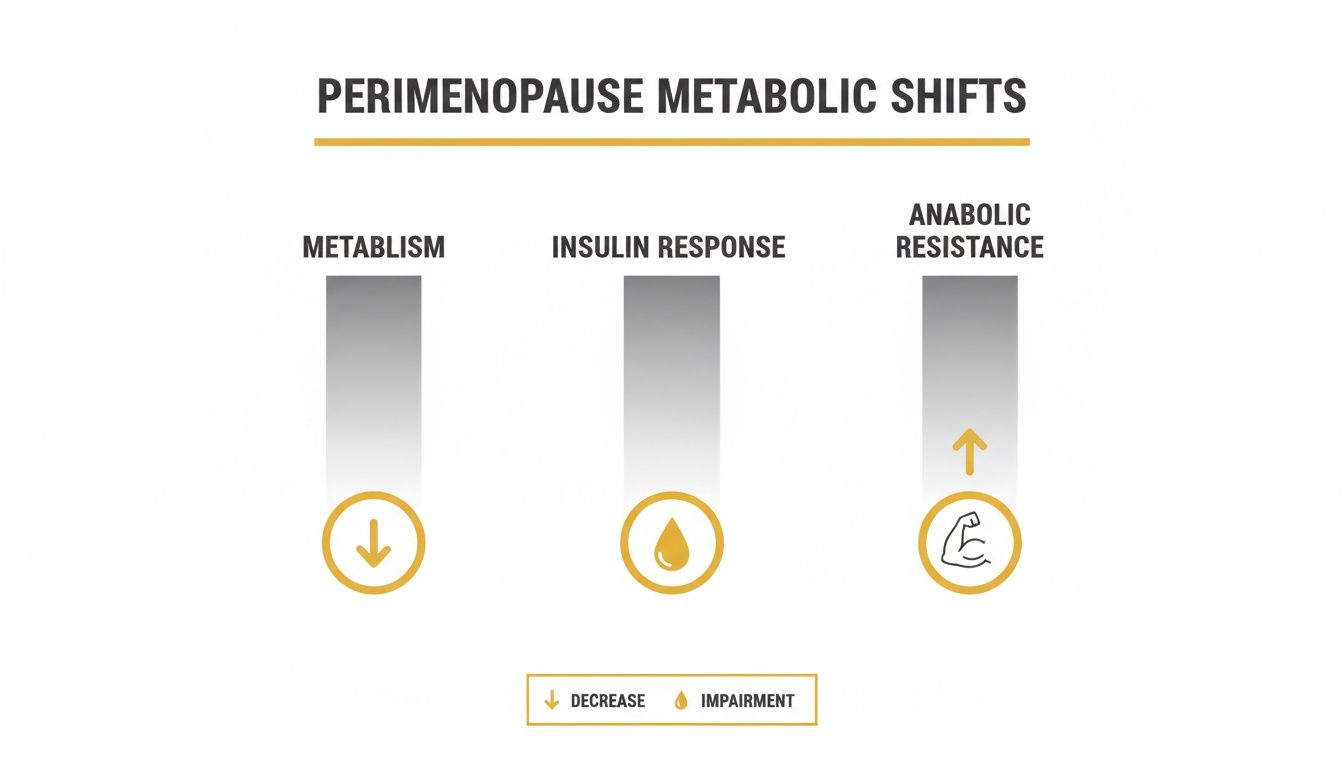
Estrogen does more than regulate the menstrual cycle — it makes muscle responsive to protein and exercise. As estrogen declines during perimenopause (typically ages 40–52), muscles become less efficient at using the protein you eat, and breakdown accelerates even when diet and activity stay the same. This is anabolic resistance: declining estrogen reduces protein synthesis efficiency at the cellular level, blunting the mTORC1 pathway that initiates muscle protein synthesis, so the same protein dose that maintained muscle in your 30s no longer does the job.
The consequences compound quickly. Women in their 40s and 50s can lose 3–8% of muscle mass per decade without intervention. Less muscle means a lower resting metabolic rate, reduced strength, and higher risk of osteoporosis, insulin resistance, and cardiovascular disease — none of which are inevitable, but all of which require a deliberate nutritional response.
Fat distribution shifts at the same time. Estrogen directs fat toward hips and thighs during reproductive years. As it falls, cortisol becomes relatively more dominant, pushing fat toward the abdomen. Visceral fat — the deep fat surrounding organs — increases systemic inflammation and further impairs muscle protein synthesis, making the cycle harder to reverse.
The standard advice to eat less and do more cardio does not account for any of this. The hormonal environment has changed, and the nutrition strategy has to change with it. That starts with substantially higher protein intake than most women are currently eating — far above the RDA of 0.8g/kg, which was designed to prevent deficiency, not support an active body navigating significant hormonal change (PROT-AGE position paper, 2013).
The Science of Anabolic Resistance
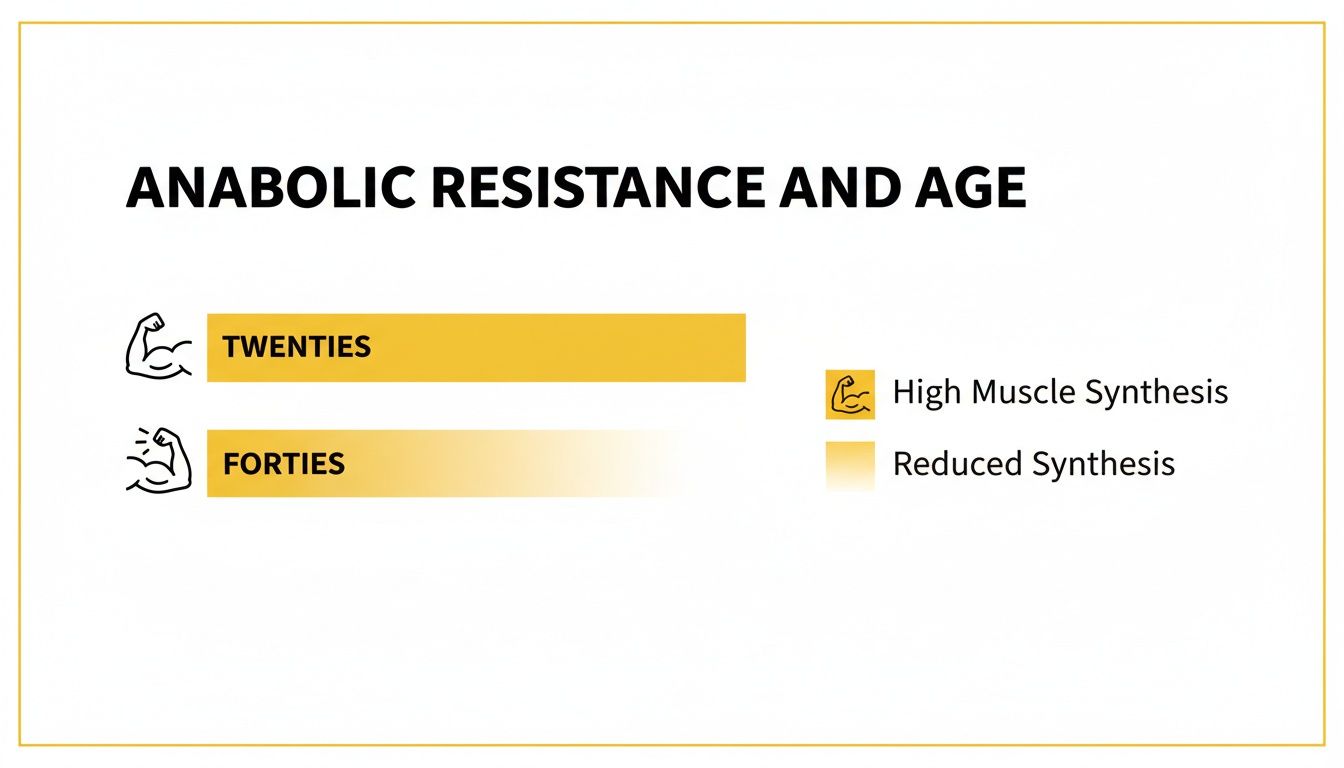
In younger women, 20–25g of protein per meal is enough to maximally stimulate muscle protein synthesis. During perimenopause, that same dose produces a significantly blunted response. Muscle tissue becomes less sensitive to amino acid signalling — particularly leucine, the trigger for the mTORC1 pathway that initiates muscle protein synthesis.
Research shows that aging muscle requires approximately 3g of leucine per serving to reliably hit that threshold (leucine-threshold systematic review, 2021). Most 20g protein servings fall short. Reaching 3g of leucine consistently requires 35–40g of high-quality protein per meal, or deliberate selection of leucine-dense sources such as whey, eggs, or beef.
Three factors compound this resistance specifically during perimenopause:
- Declining estrogen reduces protein synthesis efficiency at the cellular level
- Reduced physical activity lowers baseline anabolic sensitivity — sedentary muscle responds less to protein regardless of dose
- Lower total calorie intake creates fewer meal opportunities to hit per-meal protein targets without planning
Addressing anabolic resistance is not simply a matter of eating more. It requires restructuring intake so each meal delivers the 3g leucine threshold, pairing that intake with resistance training to restore anabolic sensitivity, and distributing protein across meals rather than backloading it at dinner — a pattern that research consistently shows limits daily muscle protein synthesis.
When Perimenopause Makes Eating Harder
Most nutrition advice assumes you wake up hungry, feel fine after eating, and have no medications in the mix. Perimenopause breaks all three assumptions. Before you troubleshoot your protein intake, you need to understand why eating itself becomes harder during this transition - and what to do about it.
Nausea and Gastric Slowing
Estrogen does not decline in a smooth, gradual line during perimenopause. It surges erratically - sometimes spiking two to three times higher than normal before crashing. Those surges slow gastric emptying. The stomach holds food longer than it should, which creates a persistent low-grade nausea that many women mistake for a stomach virus or anxiety.
The practical consequence: eating a large protein-dense meal when estrogen is surging can feel genuinely awful. This leads women to undereat at the exact meals where protein intake matters most.
What to do:
- Switch to cold or room-temperature protein foods on nausea days. Hot food smells intensify nausea. Cold Greek yogurt, chilled cottage cheese, a protein shake made with cold water, or deli turkey straight from the fridge are easier to get down.
- Shrink serving size, increase frequency. Instead of 40g of protein at one sitting, aim for 20g every 3-4 hours. A 150g serving of Greek yogurt (15g protein) at 9am, a small chicken breast (25g) at noon, and a shake (25g) at 3pm distributes the load without overwhelming a slow stomach.
- Avoid whey concentrate during nausea flares. Whey concentrate is higher in lactose and fat, both of which slow gastric emptying further. Whey isolate or egg white protein powder are lower in both and easier to tolerate.
- Ginger reduces nausea without affecting protein absorption. Add fresh ginger to shakes or drink ginger tea 15-20 minutes before eating.
Appetite Suppression From Progesterone Decline
Progesterone is mildly appetite-stimulating. As it declines in perimenopause, some women find their hunger signals weaken significantly. This creates a real problem: your protein needs are at their highest point in your adult life, but your drive to eat is lower than it has been in years.
Low hunger does not mean low need. Muscle protein synthesis still requires leucine to cross the 3g threshold. Your body will still pull from muscle tissue if dietary protein is insufficient, regardless of whether you felt hungry.
What to do:
- Prioritize protein density over volume. When appetite is suppressed, every bite needs to count. Greek yogurt delivers 10g of protein per 100g. Cottage cheese delivers 11g. Canned tuna delivers 25g per 100g drained.
- Eat protein first at every meal. Hunger is limited. Spend it on protein before it disappears. If you eat the salad first, you may not finish the chicken.
- Liquid protein is not cheating. A whey isolate shake made with water is 25g of high-quality protein in under 300ml. On days when solid food feels unappealing, a shake is a legitimate and scientifically sound strategy.
- Set a timer, not an appetite cue. If you are waiting to feel hungry before eating, you may skip meals entirely. Eat on a schedule: every 3-4 hours, regardless of hunger level.
Medication Interactions
Two medications are commonly prescribed during perimenopause that directly affect appetite and protein intake. If you are on either of these, you need a strategy.
SSRIs and SNRIs (sertraline, escitalopram, venlafaxine, duloxetine) are prescribed for hot flash severity, mood instability, and anxiety - all common in perimenopause. A well-documented side effect is appetite suppression, particularly in the first 4-8 weeks of use and during dose increases. Some women on SSRIs report losing 10-15% of their total daily caloric intake simply because they stop feeling hungry.
- Take SSRIs after a protein-containing meal, not before. Eating protein before the medication blunts appetite means the protein is already in.
- If morning appetite is suppressed, shift your largest protein meal to midday when medication effects may be less acute.
- Tell your prescriber if appetite suppression is significant. Dose timing adjustments are sometimes possible.
Metformin is increasingly prescribed during perimenopause for insulin resistance. Its most common side effects are GI: nausea, bloating, loose stools, and abdominal discomfort. High-protein meals can worsen these symptoms in some women.
- Take metformin with food consistently, not on an empty stomach.
- On days with GI symptoms, favor easier-to-digest proteins: eggs, white fish, whey isolate, Greek yogurt. Avoid high-fat red meat pairings.
- Extended-release metformin (metformin ER) has significantly lower GI side effects than immediate-release. Ask your prescriber whether this is an option.
Gut Changes and Protein Digestion
Stomach acid production declines with age. Adequate stomach acid is required to denature dietary protein and activate pepsinogen into pepsin, the enzyme that begins protein breakdown. Lower acid levels mean less efficient protein digestion, even if your intake looks adequate on paper.
Signs this may be affecting you: feeling full very quickly after eating protein, bloating after meat or eggs, or protein foods sitting heavily.
What to do:
- Digestive enzyme supplements with protease can partially compensate. Look for formulas that include protease, betaine HCl, and pepsin. Take them at the start of a protein-containing meal.
- Chew thoroughly. Mechanical breakdown increases surface area for enzymatic digestion.
- Favor easier-to-digest proteins on high-symptom days. Eggs, white fish, and whey isolate are more digestible than red meat and whole beans.
How Much Protein You Actually Need
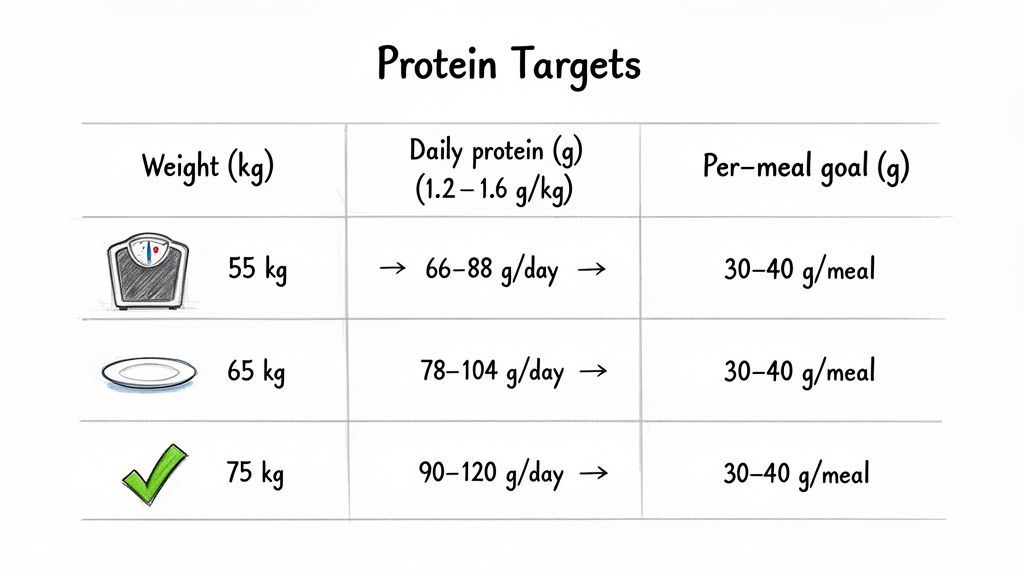
Dr. Stacy Sims recommends a daily target of ~2.2g per kg of body weight — simplified as roughly 1g per pound for easy recall. That means:
- Per meal minimum: 35–40g of high-quality protein to reliably hit the leucine threshold
- Leucine per meal: At least 3g to trigger muscle protein synthesis
For a 68kg (150lb) woman, this works out to approximately 150g of protein per day across 3–4 meals. For an 80kg (176lb) woman: around 176g daily.
Plant-based eaters should add 15% to these targets. Plant proteins have lower digestibility and less leucine per gram than animal sources, so the daily number needs to be higher to produce the same muscle-building signal. Prioritise soy, edamame, and tempeh, and consider a leucine-enriched plant protein powder to close the gap.
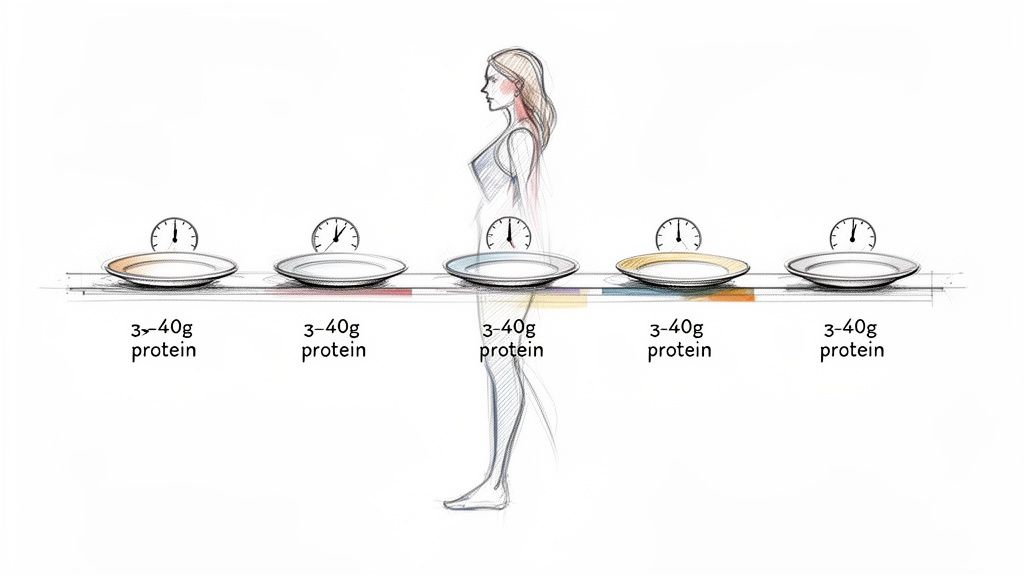
Distribution matters as much as the daily total. Spreading protein evenly across 3–4 meals produces meaningfully better muscle protein synthesis than loading it into one or two sittings. A small breakfast of 10g followed by a large dinner of 80g will not produce the same result as three meals of 40–50g each, even if the daily total is identical.
Meal Timing and Distribution
Spread protein across three meals of 35–40g each — this is the structural goal for perimenopause protein intake.
Breakfast (35–40g): After 8–10 hours without food, muscle protein synthesis is running negative. A high-protein breakfast reverses this immediately. Practical options: 3 eggs + 200g Greek yogurt (~35g combined), or a quality whey protein shake alongside a whole-food meal.
Post-workout (35–40g, within 30–60 minutes): Resistance training temporarily raises anabolic sensitivity. Eating protein in this window amplifies muscle protein synthesis beyond what either stimulus produces alone — making this the highest-priority protein meal of the day.
Dinner (35–40g): Anchor the evening meal around protein. Including a slow-digesting source such as cottage cheese, Greek yogurt, or other dairy (casein-rich) reduces muscle breakdown overnight — the longest fasting period in any given day.
A sample day across all three windows: - Breakfast: 3 scrambled eggs + 200g Greek yogurt + 1 tbsp nut butter = ~38g - Lunch: 150g chicken breast + 100g quinoa + large salad = ~45g - Post-workout: 30g whey protein + 250ml milk = ~38g - Dinner: 150g salmon + 200g edamame + roasted vegetables = ~48g - Daily total: ~169g
The Best Protein Sources for Perimenopause
The most useful way to rank protein sources is by leucine content per serving — not just total protein.
| Food | Serving | Protein | Leucine |
|---|---|---|---|
| Whey protein isolate | 30g scoop | 27g | 3.0g |
| Chicken breast (cooked) | 150g | 47g | 3.7g |
| Salmon (cooked) | 150g | 40g | 3.2g |
| Tuna (canned) | 150g | 40g | 3.1g |
| Beef (lean, cooked) | 120g | 36g | 3.0g |
| Greek yogurt | 200g | 20g | 1.8g |
| Cottage cheese | 200g | 24g | 2.2g |
| Eggs | 3 large | 19g | 1.5g |
| Tempeh | 150g | 24g | 1.8g |
| Edamame | 200g | 17g | 1.4g |
| Firm tofu | 200g | 17g | 1.3g |
| Lentils (cooked) | 200g | 18g | 1.4g |
Animal proteins clear the 3g leucine threshold more easily. A 150g chicken breast or salmon fillet does so in a single serving. Most plant proteins fall short on their own, but stacking sources closes the gap: edamame (1.4g) paired with tempeh (1.8g) in the same meal delivers 3.2g leucine across 41g total protein. Adding a scoop of unflavored soy or whey protein powder to a plant-heavy meal is the most efficient fix when volume is a limiting factor.
Micronutrients That Support Muscle and Hormonal Health
Protein does the heavy lifting, but three micronutrients directly affect how well your body builds and retains muscle during perimenopause — and most women over 40 are low in at least one of them.
Vitamin D: Muscle cells have vitamin D receptors, and deficiency measurably impairs muscle protein synthesis. Low vitamin D is also strongly associated with higher rates of sarcopenia. Target a blood level of 40–60 ng/mL — most women need 1,500–2,000 IU daily from supplementation to get there.
Magnesium: This mineral is required for more than 300 enzymatic reactions, including those involved in protein synthesis and sleep. Low magnesium raises cortisol, which accelerates visceral fat accumulation and muscle breakdown. Target 310–320mg daily from food (leafy greens, nuts, seeds, dark chocolate) or a supplement if your diet consistently falls short.
Omega-3 fatty acids (EPA/DHA): Omega-3s reduce the inflammatory environment that drives anabolic resistance. Research in the American Journal of Clinical Nutrition found that 3g of EPA/DHA daily increased muscle protein synthesis rates in older adults. Aim for 2–3g EPA+DHA daily from fatty fish or an algae-based supplement if you avoid fish.
These three work in the background to make your protein intake more effective — not replacements for it, but necessary support.
Plant-Based Protein in Perimenopause: A Complete Strategy
Eating plant-based during perimenopause is entirely workable. But it requires more precision than eating omnivore, and the standard advice to "just eat more beans" is not sufficient. Here is what the science actually requires.
Why Plant Proteins Are Harder to Use
The core issue is not just total protein quantity - it is amino acid quality and digestibility.
Leucine density is lower in plants. Muscle protein synthesis is primarily triggered by leucine, and the threshold is approximately 3g per meal. Animal proteins reach this threshold easily: 30g of whey protein contains about 3g of leucine. To get the same leucine from lentils, you would need to eat roughly 230g of cooked lentils, which delivers only about 18g of total protein but also 16g of fiber, significant volume, and a large carbohydrate load.
Digestibility scores are lower. The DIAAS (Digestible Indispensable Amino Acid Score) is the current gold standard for protein quality. Whey scores 1.09. Whole egg scores 1.13. Pea protein isolate scores around 0.82. Cooked lentils score around 0.59. A DIAAS of 0.59 means that even if the label says 18g of protein, your body is accessing meaningfully less.
The practical implication: increase total intake by 15-20%. If your target is 120g of protein per day on an omnivore diet, a fully plant-based diet requires approximately 138-144g to achieve equivalent muscle protein synthesis stimulus.
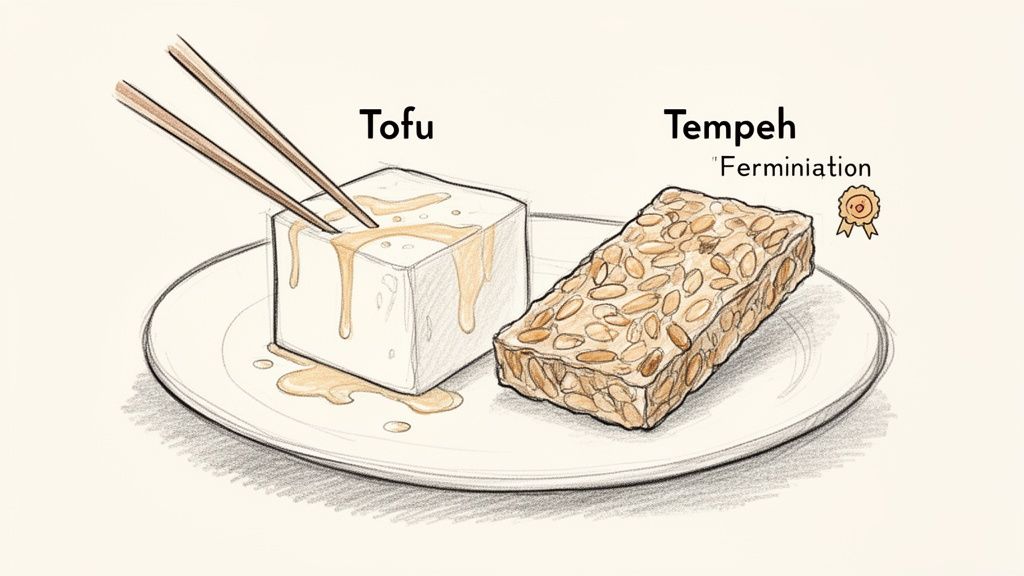
Best Plant Protein Sources Ranked by Leucine Content
| Food | Leucine per 100g | Total protein per 100g |
|---|---|---|
| Soy protein isolate powder | 8.0g | 90g |
| Seitan | 1.5g | 25g |
| Edamame (cooked) | 1.4g | 11g |
| Tempeh | 1.2g | 19g |
| Hemp seeds | 1.0g | 31g |
| Tofu (firm) | 0.9g | 8g |
| Lentils (cooked) | 0.65g | 9g |
| Quinoa (cooked) | 0.25g | 4g |
Soy protein isolate and seitan are the clear leaders. Edamame and tempeh are strong whole-food options. Lentils and quinoa are nutritious but require large quantities to deliver meaningful leucine.
Practical Meal Combinations That Clear the Leucine Threshold
Getting 3g of leucine from plants without animal products requires stacking sources.
Breakfast: 40g soy protein isolate in a shake (3.2g leucine) + 100g edamame on the side. Total leucine: approximately 4.6g. Total protein: approximately 47g.
Lunch: 150g tempeh (approximately 1.8g leucine) + 100g edamame (1.4g leucine). Total leucine: 3.2g. Total protein: approximately 40g.
Dinner: 200g firm tofu (1.8g leucine) + 80g hemp seeds stirred into a sauce or dressing (0.8g leucine) + 100g cooked lentils (0.65g leucine). Total leucine: approximately 3.25g. Total protein: approximately 51g.
Choosing a Plant Protein Powder
Soy protein isolate is the gold standard for plant protein powders. It has the highest DIAAS of all plant sources (approaching 1.0 in isolate form), the highest leucine density, and decades of safety data. Concerns about phytoestrogens and breast cancer risk have not been supported by clinical evidence at moderate consumption (1-2 servings per day). For women with a history of hormone-sensitive cancers, discuss with your oncologist.
Pea protein + rice protein blend (80:20 ratio) is the best soy-free option. Pea protein is high in lysine but low in methionine. Brown rice protein is the reverse. Combined, they approximate a complete amino acid profile. A 30g serving of a quality blend delivers approximately 2.2-2.5g of leucine - you need slightly more per serving than soy isolate to hit the threshold.
Hemp protein offers omega-3 fatty acids and fiber but has a DIAAS around 0.63. Useful as a food supplement, but should not be your primary protein powder.
Key Micronutrient Considerations for Plant-Based Women Over 40
Eliminating animal products affects several nutrients that directly impact muscle health and function in perimenopause:
- Vitamin B12: Found almost exclusively in animal foods. Deficiency causes fatigue frequently misattributed to perimenopause. Supplement with 500-1000mcg methylcobalamin daily.
- Iron: Plant-based iron (non-heme) has significantly lower bioavailability than heme iron. Pair iron-rich plant foods (lentils, tofu, pumpkin seeds) with vitamin C to increase absorption by up to 60%. Avoid coffee and tea within an hour of iron-rich meals.
- Zinc: Phytates in legumes and grains bind zinc and reduce absorption. Soaking legumes and choosing fermented soy (tempeh, miso) reduces phytate load.
- Calcium: Fortified plant milks, tofu made with calcium sulfate, and leafy greens (bok choy, kale, collards) are the best sources. Aim for 1,200mg daily during perimenopause. Supplement in split doses of no more than 500mg at a time for best absorption.
Whey Protein for Perimenopause Women
Whey protein is the highest leucine-density food source available. A 30g scoop delivers 2.8–3.0g leucine — close to but sometimes just under the 3g threshold. Combining a scoop with Greek yogurt or cottage cheese reliably clears that threshold without a large calorie load.
Choosing between whey types: - Whey concentrate: 70–80% protein by weight, 3–5g lactose per serving. Best for women without lactose sensitivity. - Whey isolate: 90%+ protein by weight, under 1g lactose. Better for those with lactose sensitivity or who want minimal carbohydrates. - Whey hydrolysate: Pre-digested for faster absorption. Marginally beneficial for most women and significantly more expensive — not worth the premium unless recovering from surgery or illness.
Quality markers to look for: At least 2.5g leucine per 25g serving; third-party certified (NSF Certified for Sport or Informed Sport); no proprietary blends; transparent heavy metal testing.
Whey protein does not cause bulking or masculinisation in women. Female testosterone runs 10–20 times lower than male levels, so the hormonal conditions for rapid hypertrophy are not present. What consistent use does produce is better muscle retention, improved body composition, and faster recovery between sessions.

The Role of Strength Training
Protein and resistance training depend on each other. Protein provides the raw material for muscle repair; resistance training makes muscle tissue receptive to it. Without the training stimulus, even optimal protein intake cannot prevent muscle loss.
For women in perimenopause, the evidence-based approach includes:
- Frequency: 2–3 sessions per week
- Intensity: Working to within 2–3 reps of muscular failure — this is where the adaptation signal originates
- Volume: 10–20 sets per muscle group per week for maintenance and growth
- Progressive overload: Gradually increasing weight, reps, or sets over time — the muscle must be challenged beyond its current capacity to adapt
- Exercise selection: Compound movements — squats, deadlifts, rows, presses — recruit the most muscle fibre and produce the strongest hormonal response
Cardio supports cardiovascular and metabolic health but does not preserve muscle mass. Women who rely exclusively on cardio during perimenopause lose muscle at roughly the same rate as sedentary women, regardless of how much protein they eat. The resistance training stimulus cannot be substituted.
Managing Perimenopause Belly Fat Through Nutrition
Visceral fat accumulation in perimenopause is driven by falling estrogen and rising cortisol — protein addresses this through three concrete mechanisms.
Thermic effect: 20–30% of protein calories are burned during digestion and metabolism, the highest of any macronutrient. At a daily intake of 150g, that's 30–45g worth of calories expended simply through processing.
Appetite regulation: High-protein meals suppress ghrelin and raise PYY and GLP-1, the hormones that signal fullness. This makes sustaining a mild caloric deficit significantly easier without constant hunger.
Muscle preservation and resting metabolism: Each kilogram of muscle burns roughly 13 calories per day at rest. Losing 5kg of muscle over a decade — common without intervention — cuts resting metabolism by 65 calories per day, or nearly 24,000 calories per year. That deficit accumulates as fat.
On carbohydrates: pairing them with protein and fibre blunts the insulin response and reduces visceral fat signalling. This is not an argument for low-carb eating — it's about meal structure.
Women who combine adequate protein intake with resistance training see the greatest reduction in perimenopause belly fat. Neither strategy alone produces the same result as both together.
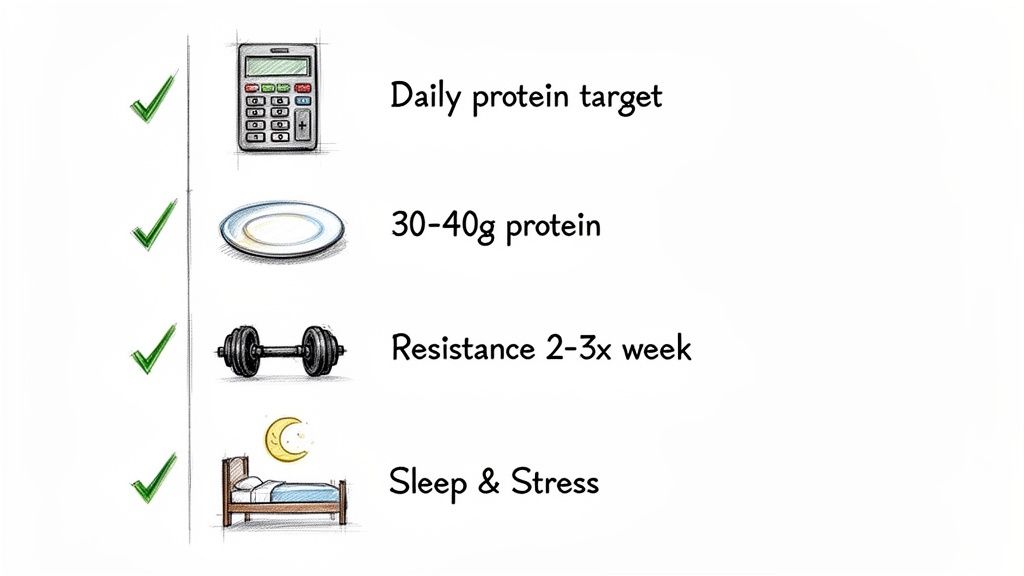
Your Action Plan: Getting Started
Week 1 — Establish your target Calculate your daily protein goal: roughly 1g per pound of body weight (2.2g/kg). A 150-pound woman needs around 150g daily. Track your current intake for three days using a food diary or protein tracker app. Most women find they are hitting 60–80g — about half of what perimenopause demands require to support muscle and metabolism.
Week 2 — Fix breakfast first Hit 35–40g of protein at breakfast before anything else changes. Practical options: 3 eggs plus 200g Greek yogurt; a quality whey protein shake with 2 eggs; 200g cottage cheese with nuts and fruit. A strong breakfast anchors protein distribution across the rest of the day.
Week 3 — Add resistance training Start with two sessions per week: one lower body (squats, deadlifts, lunges), one upper body (rows, press, overhead press). Three sets of 8–12 reps, with the last two reps genuinely difficult. Simple and consistent outperforms complex and sporadic.
Week 4 — Prioritise post-workout protein Eat 35–40g of protein within 30 minutes of finishing resistance training. A whey shake, Greek yogurt, or chicken breast all meet this threshold. Timing matters here more than at any other meal.
Ongoing — Verify leucine per meal Once a week, check that each main meal reaches the 3g leucine threshold. If a meal falls short, add Greek yogurt, a hard-boiled egg, or a scoop of protein powder.
Women who consistently hit these targets alongside resistance training report measurable muscle gains and visceral fat reduction within 12–16 weeks. The habits built now compound across the decades ahead.
Troubleshooting: Hitting Your Protein Target When Life Gets in the Way
The gap between knowing your protein target and consistently hitting it is where most women lose ground. These are the specific scenarios that derail protein intake, with concrete strategies for each.
Low Appetite Days
On days when hunger is low, volume becomes the enemy. The goal is maximum protein with minimum bulk.
Highest protein density foods by volume:
- Greek yogurt (2% or full fat): 10g per 100g
- Cottage cheese (2%): 11g per 100g
- Canned tuna in water: 25g per 100g drained
- Whey isolate powder: 25g protein per 30g scoop
- Edamame (shelled): 11g per 100g, can eat cold, little prep required
- Deli turkey or chicken: 20-22g per 100g
Getting 40g of protein in under 300 calories:
- 200g Greek yogurt (20g protein) + one scoop whey isolate stirred in (25g protein) = 45g protein, approximately 280 calories.
- 150g cottage cheese (16g protein) + 100g canned tuna (25g protein) = 41g protein, approximately 210 calories.
- Two scoops whey isolate in 300ml water = 50g protein, approximately 200 calories. Not satisfying as a meal, but effective when eating anything solid feels like a project.
Set a minimum for low appetite days. Aim for 70% of your daily target with a focus on hitting at least 2.5g leucine per meal. This preserves the muscle protein synthesis stimulus even when total volume is lower.
Travel
Airport strategies:
- Greek yogurt cups (Chobani, Fage travel sizes) are available in most airport convenience stores and cafes. One 170g cup = 15-17g protein.
- Deli turkey packets at convenience stores: 11g protein per 56g serving, shelf-stable for several hours.
- Hard-boiled eggs: stocked at Starbucks and most airport cafes. Two eggs = 12g protein.
- Protein bars: most bars are 10-15g protein with high sugar content. Look for Quest bars (21g protein), RXBars (12g from egg whites and almonds), or ONE bars (20g protein). Read the label.
- Pack a protein powder single-serve packet and a shaker bottle. This is a reliable fallback for any day where meals do not land.
Hotel strategies:
- Hotel breakfast is usually workable. Scrambled eggs + cottage cheese (if offered) + smoked salmon. Three eggs + 150g cottage cheese = 33g protein before 9am.
- Request a mini-fridge. Stock it on day one: Greek yogurt, string cheese, deli turkey. This prevents defaulting to room service meals that are carbohydrate-heavy.
Social Situations and Eating Out
Hitting 35-40g of protein at a restaurant meal is straightforward if you know what to order.
The easiest cuisines:
- Greek: Grilled fish, grilled chicken, lamb chops, shrimp. Ask for extra protein, not extra pita. A grilled salmon entree is 35-45g protein.
- Japanese: Sashimi, edamame, tofu dishes, grilled chicken teriyaki, miso-glazed salmon. A standard sashimi platter with edamame gives 40g+ protein easily.
- Mexican: Grilled chicken or steak bowls with double protein, carne asada plates. Ask for extra meat and reduce the rice.
General ordering strategy:
- Always identify the protein anchor first (grilled chicken, fish, steak, shrimp). Everything else is secondary.
- Ask for double protein when ordering bowls or tacos. This is a normal and common request.
- If the entree looks protein-light, order a protein-forward appetizer (shrimp cocktail, sashimi, chicken skewers) rather than bread or chips.
You do not need to negotiate. "Can I get extra chicken?" is a three-word sentence that increases your protein by 20g.
Cooking for the Family
You do not need to cook two separate meals.
- Double your protein portion at dinner. Everyone else gets one chicken breast. You get two. Same dish, same sauce, same vegetables.
- Add protein powder to shared foods. Unflavored whey isolate dissolves invisibly into pasta sauces, soups, and oatmeal. One scoop adds 20-25g of protein to a family dish with no detectable flavor change.
- Batch cook hard-boiled eggs. Six to eight eggs cooked on Sunday handle the days when cooking anything feels impossible.
The 80% Rule: Why Imperfect Weeks Do Not Erase Progress
Research from the Journal of Nutrition found that habitual protein intake averaged over 2-week periods predicted lean mass better than single-day intake measurements. Muscle is not immediately lost from one low-protein day. Muscle loss from inadequate protein intake is a chronic, cumulative process.
The threshold that matters is weekly average. If your target is 120g daily and you hit 80g on three days, aim for approximately 133g on the other four days to land at the weekly average. That is achievable.
On difficult days, aim for 70% of your target. On normal days, aim for 100%. Do not try to dramatically overshoot on good days to compensate - protein has a ceiling effect, and eating 200g in a day does not provide double the muscle protein synthesis of 120g.
Consistency over perfection. A year of 85% adherence produces far better outcomes than two months of perfect adherence followed by abandonment.
Frequently Asked Questions
Why do I need so much more protein now than I did in my 30s?
Declining estrogen reduces muscle cell sensitivity to amino acids—specifically leucine, which triggers the mTORC1 pathway that initiates muscle protein synthesis. The same 20–25g dose that worked in your 30s now produces a blunted response. You need 35–40g per meal and at least 3g of leucine to reliably stimulate muscle building at the same rate, even though your body's actual protein requirement hasn't increased—your body's responsiveness to it has declined.
Can I just take a protein supplement instead of eating whole foods?
Protein powder is a useful tool for hitting your per-meal target, especially post-workout or at breakfast, but it should not replace whole foods entirely. Whole foods provide micronutrients (vitamin D, magnesium, omega-3s) that support muscle protein synthesis and metabolic health alongside the protein itself. Use powder to bridge gaps in real meals, not as a complete meal replacement.
Is it true that high protein intake damages your kidneys?
No—this is a persistent myth based on outdated research. Current evidence shows that protein intake of 2–2.2g/kg is safe for women with normal kidney function. If you have pre-existing kidney disease, discuss your target with your doctor, but for healthy women in perimenopause, the evidence supports this level of intake without adverse effects.
If I do cardio instead of strength training, can I still prevent muscle loss with high protein?
No. Protein provides the raw material for muscle repair, but resistance training provides the stimulus that makes muscle tissue receptive to that protein. Women who do cardio exclusively lose muscle at roughly the same rate as sedentary women, regardless of protein intake. Resistance training is the non-negotiable foundation—cardio supports cardiovascular health but cannot replace it for muscle preservation.
How quickly will I see results if I start this plan today?
You may notice improved energy and better recovery between workouts within 2–3 weeks. Measurable changes in muscle mass and body composition typically appear within 12–16 weeks of consistent protein intake (35–40g per meal) paired with 2–3 resistance training sessions per week. Patience compounds—these habits built now create significant advantages across the decades ahead.
This article is for education only and is not medical advice. Just Protein is not a medical provider — we summarize published research and cite our sources so you can verify them; decisions about perimenopause, medications, supplements, and your individual protein needs belong with your doctor.
