

TL;DR
- Women over 40 need approximately 2.2g of protein per kilogram of body weight daily — or about 1g per pound — significantly higher than the outdated 0.8g/kg RDA, to counter anabolic resistance and preserve muscle, bone density, and metabolism.
- Distribute protein across three meals at 35–40g per meal rather than loading it at dinner; this consistent approach triggers better muscle protein synthesis than total daily intake alone.
- Leucine directly activates muscle repair after 40 and requires at least 3g per meal to be effective — prioritize complete proteins like chicken, eggs, Greek yogurt, or tofu.
- Start with breakfast: adding 30–40g of protein to your morning meal is the highest-impact single change for women over 40.
- The simplified rule: divide your weight in pounds by 1 — that number in grams is your daily protein target.
For women over 40, protein does more than build muscle — it supports bone density, metabolic function, and recovery as hormonal shifts begin to change how the body processes nutrients. Yet most general dietary guidelines still reflect requirements for younger adults, leaving a meaningful gap for this life stage.
So how much protein do women need once they're past 40? Research by exercise physiologist Dr. Stacy Sims — who has built her career studying female-specific physiology — points to a daily target of 1.6 to 2.2 grams per kilogram of body weight, or about 1 gram per pound as the easy rule to remember. This is far above the long-standing RDA of 0.8g/kg, which was designed to prevent deficiency, not to support an active, aging female body.
The number itself is only part of the picture. Timing and distribution matter just as much: spreading protein intake across three meals — rather than loading it into one or two — gives your muscles a more consistent supply of amino acids throughout the day. Aiming for 35–40 grams per meal minimum is the practical threshold.
This article covers what drives the higher requirement, which foods deliver the most usable protein, how needs shift with activity level, and what commonly gets misunderstood about protein for women.
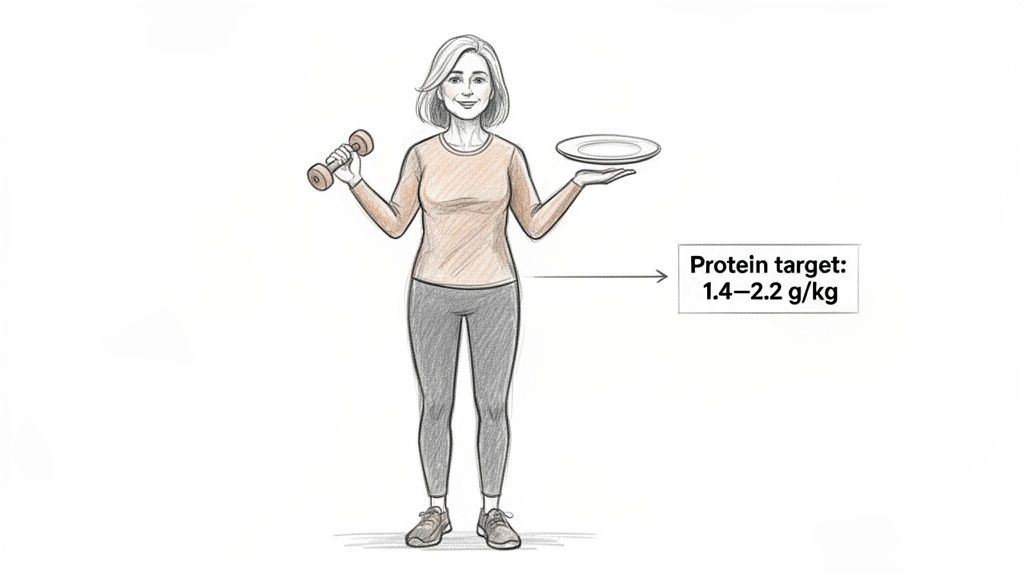
A Clear Answer to Your Protein Questions
The table below cuts through the math and gives you a ready-to-use daily target based on your body weight, using the ~2g/kg protocol.
Quick Protein Targets for Women Over 40
| Your Body Weight | Daily Protein Goal (~2g/kg) | Per-Meal Minimum (3 meals/day) |
|---|---|---|
| 50 kg (110 lb) | ~100g | ~33g |
| 60 kg (132 lb) | ~120g | ~40g |
| 68 kg (150 lb) | ~136g | ~45g |
| 75 kg (165 lb) | ~150g | ~50g |
These numbers use ~2g/kg for clean math — Dr. Stacy Sims's precise recommendation is 1.6 to 2.2g/kg depending on activity level, well above the U.S. RDA of 0.8g/kg, which is set only to prevent deficiency, not to support muscle retention or metabolic health after 40.
The simplest way to calculate your target:
1. Divide your weight in pounds by 1 — that number in grams is your daily goal.
(Example: 150 lb → 150g protein/day)
2. Or divide your weight in pounds by 2.2 to get kilograms, then multiply by 2.
3. Split that total as evenly as possible across three meals.
You can also use the protein intake calculator to get your number instantly.
Once you have your daily number, split it as evenly as possible across three meals. Research consistently shows that distributing protein throughout the day — rather than loading it at dinner — does more to support muscle protein synthesis than total intake alone.
If your current breakfast is protein-light, that's the most effective place to start. Aim for 35–40g at breakfast — it's the meal most women get least right, and fixing it drives the biggest daily improvement.
How Much Protein Does Dr. Stacy Sims Recommend for Women Over 40?
Dr. Stacy Sims, exercise physiologist and nutrition scientist, is one of the leading researchers on protein needs specific to women. Her work directly addresses how hormonal changes during perimenopause and menopause alter the way women process and use protein — and why guidelines built on male-participant studies fall short.
Dr. Stacy Sims recommends women over 40 aim for roughly 1.6 to 2.2 grams of protein per kilogram of body weight per day — closer to 2.2 g/kg during perimenopause and menopause. For a 150 lb (68 kg) woman, that's about 110–150 grams of protein daily. The lower end (1.6g/kg) applies to moderately active women focused on maintaining muscle. The upper end (2.2g/kg) targets women doing regular strength training or managing significant hormonal changes during perimenopause. Both ends of this range far exceed the standard RDA of 0.8g/kg. The reason for the higher target is simple: it's what it takes to counter muscle loss after menopause, which accelerates as estrogen declines.
| Activity Level | Dr. Stacy Sims' Target | Notes |
|---|---|---|
| Moderately active (walking, light exercise) | 1.6 g/kg/day | Absolute minimum for women over 40 |
| Active (regular cardio or strength training) | 1.8–2.0 g/kg/day | Supports muscle maintenance through hormonal change |
| Strength-focused or in perimenopause | 2.2 g/kg/day | Full Sims recommendation for muscle preservation |
The reason for the elevated target is anabolic resistance — as estrogen declines, muscles become less sensitive to protein, requiring a higher per-meal dose to trigger the same repair and growth response. Sims also identifies the per-meal distribution of 35–40g as critical: spreading protein across three meals activates muscle protein synthesis three times daily instead of once.
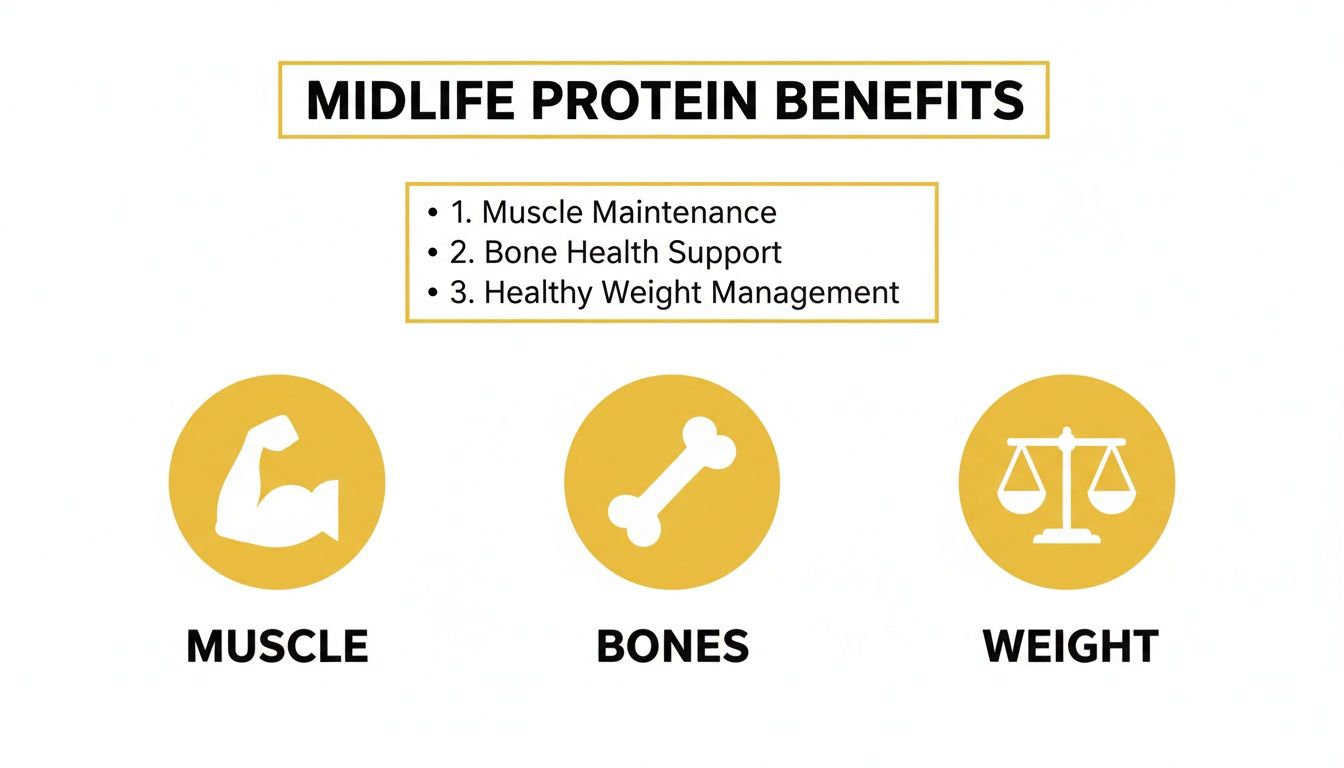
Why Your Body Needs More Protein After 40
After 40, hormonal shifts — particularly declining estrogen — make your muscles less responsive to protein. This phenomenon, called anabolic resistance, means your body needs a higher protein dose per meal to trigger the same repair and rebuilding response it once managed easily.
But the case for more protein goes beyond muscle alone.
- Bone density: Muscle and bone health are directly linked. As estrogen drops, bone loss accelerates. Adequate protein, combined with resistance training, helps preserve the structural framework that keeps fractures at bay.
- Metabolic rate: Lean muscle burns calories at rest. Losing it slows your metabolism — a common complaint after 40. Eating enough protein is one of the most effective ways to slow that loss.
- Satiety: Protein is the most satiating macronutrient. Higher intake helps stabilize blood sugar, reduce cravings, and prevent the energy crashes that become more common during perimenopause.
Dr. Stacy Sims's research shows that women specifically — not just older adults generally — need 1.6 to 2.2g/kg per day to maintain muscle, support hormonal health, and stay strong through midlife. The standard sports medicine range of 1.2–1.7g/kg was developed primarily from male-participant studies and underestimates what women over 40 actually need. See how metabolism after 40 compounds this further.
Distributing that protein evenly across meals — rather than loading it at dinner — also matters. Your muscles can only use so much protein at one sitting, so consistency throughout the day drives better results.
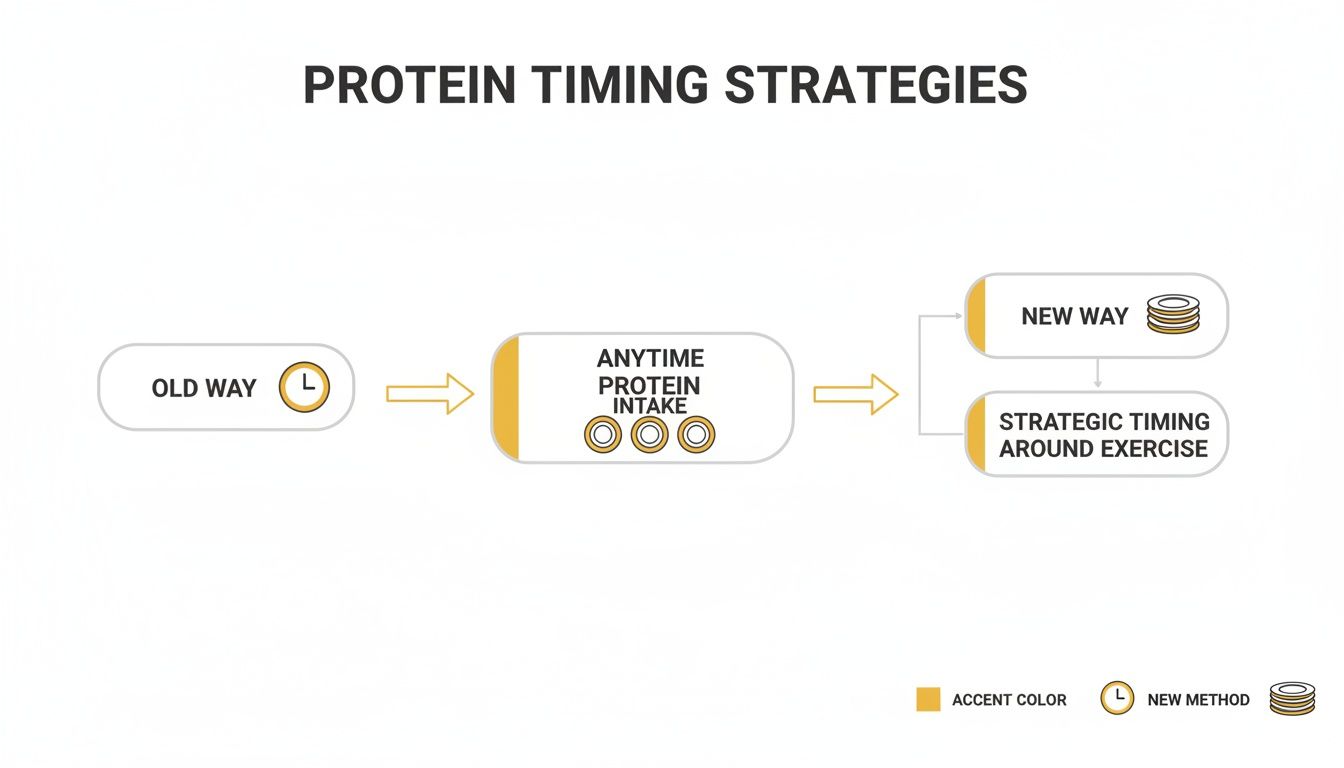
Shifting from Daily Totals to Per-Meal Goals
Hitting your daily protein number matters, but when you eat that protein matters just as much. A day that ends with a protein-heavy dinner and two small meals before it won't stimulate muscle repair as effectively as one where protein is distributed evenly across meals.
Because of anabolic resistance, muscles after 40 need a stronger per-meal signal to trigger protein synthesis. That means a minimum of 35–40 grams per meal — not 15–20 grams spread thinly across the day.
The 35-Gram Meal Threshold
Research has shifted focus from daily totals toward meal-level targets. While younger adults may respond to 20 grams per meal, women over 40 need closer to 35–40 grams per sitting to reliably stimulate muscle repair. Dr. Stacy Sims specifically identifies this higher per-meal threshold as critical for overcoming anabolic resistance after 40. The Mayo Clinic Health System has noted these evolving guidelines as well.
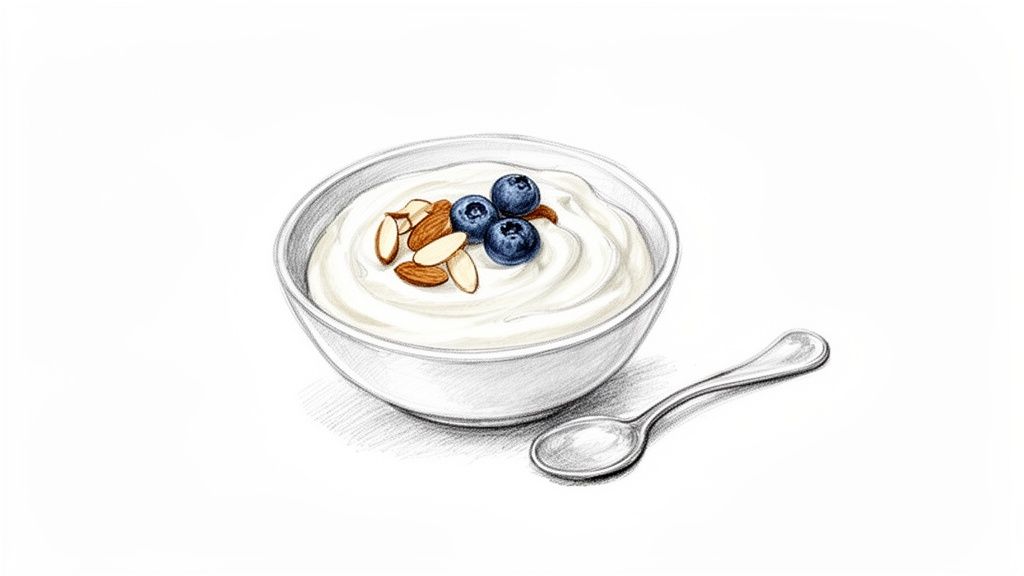
A Tale of Two Breakfasts
Breakfast is where most women fall shortest on protein. Here's what that gap looks like in practice:
Typical low-protein breakfast (~10g protein):
- Two slices of toast with jam
- Coffee with a splash of milk
- Small glass of orange juice
Optimized high-protein breakfast (~38g protein):
- One cup of plain Greek yogurt (23g)
- One small scoop of quality whey or plant protein mixed in (12g)
- A tablespoon of hemp seeds (3g)
That single swap front-loads your protein when your body is primed to use it, reduces hunger through the morning, and meets the threshold needed to actually stimulate muscle synthesis. Build each meal around a protein anchor first, then add everything else around it.
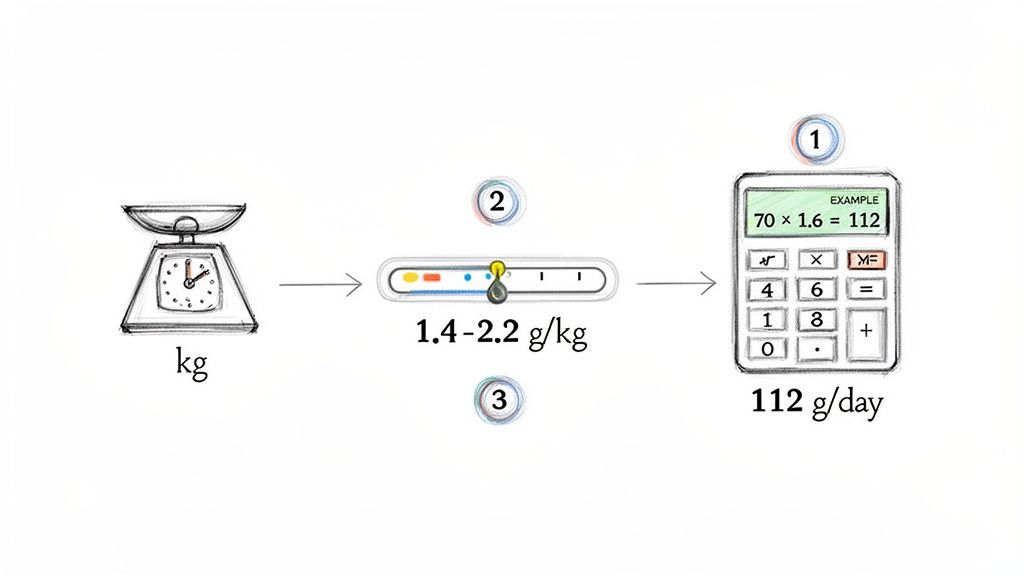
Calculating Your Personal Protein Target
Two methods make this straightforward. Use whichever fits how you think about food.
The Simple 1g-Per-Pound Rule
The easiest way: aim for 1 gram of protein per pound of body weight per day. A 150-pound woman targets 150g. A 130-pound woman targets 130g. No calculator needed.
This rule reflects the ~2g/kg protocol in a form that's easy to remember and apply at every meal.
The Grams Per Kilogram Method
Divide your weight in pounds by 2.2 to get your weight in kilograms, then multiply by your target g/kg based on Dr. Stacy Sims's range of 1.6–2.2g/kg. Using ~2g/kg gives slightly lower but still acceptable numbers for easy mental math.
| Body Weight | Target (2.2 g/kg) | Simplified (2g/kg) |
|---|---|---|
| 130 lb (59 kg) | ~130g/day | ~118g/day |
| 150 lb (68 kg) | ~150g/day | ~136g/day |
| 170 lb (77 kg) | ~170g/day | ~154g/day |
Adjusting for Your Goal
| Goal | Target Range | Notes |
|---|---|---|
| Maintain muscle | ~1.6–2.0 g/kg | Absolute minimum for women over 40 |
| Fat loss, preserve muscle | ~2.0–2.2 g/kg | Higher protein protects muscle in deficit |
| Very active or strength-focused | ~2.2+ g/kg | Dr. Stacy Sims's full recommendation |
These are starting points. Revisit your target if your training load, goals, or activity level change significantly.
Why Protein Quality Is Just as Important
Knowing how much protein do women need is only half the equation — the source matters just as much as the amount.
Protein is made up of amino acids, and nine of them are essential, meaning your body can't produce them and must get them from food. High-quality proteins contain all nine; lower-quality sources are missing one or more.
The Role of Leucine
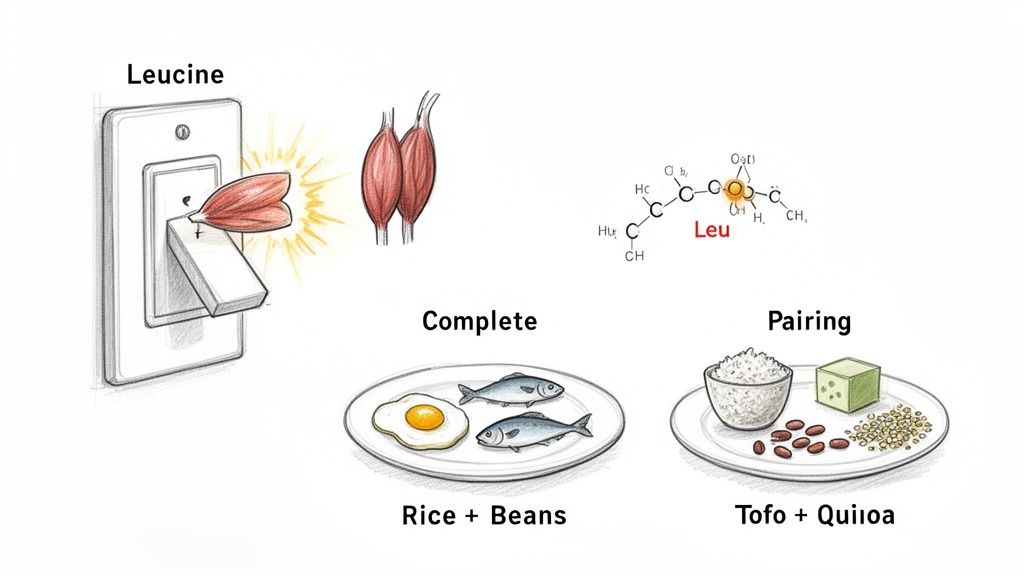
Of the nine essential amino acids, leucine directly triggers muscle protein synthesis. After 40, muscles require a higher leucine dose per meal to activate that process effectively. Dr. Stacy Sims identifies 3g of leucine per meal as the minimum threshold for women over 40 — a level you can reliably hit with a 3-oz serving of chicken, salmon, or cottage cheese. Most plant proteins fall short on their own, which is why source selection matters more as you age.
Complete vs. Incomplete Proteins
- Complete proteins (all nine essential amino acids): meat, poultry, fish, eggs, dairy, soy (tofu, tempeh, edamame)
- Incomplete proteins (missing one or more): beans, lentils, nuts, seeds, most grains
For Plant-Based Eaters
Combining plant sources — even across the day, not necessarily in one meal — fills the amino acid gaps. Aim for the upper end of your range (~2.2g/kg) and add +15% to your daily target to compensate for lower leucine absorption in plant proteins:
- Rice + beans — grains are low in lysine; legumes supply it
- Hummus + whole-wheat pita — chickpeas and grain complement each other
- Quinoa + black beans — quinoa is nearly complete; beans reinforce it
- Tofu + any grain — soy is already complete, making it the strongest plant option
Prioritizing leucine-rich, complete proteins at each meal means you get more functional benefit from every gram you eat.
Your Action Plan for Nailing Protein
Consistency matters more than perfection here. These four steps turn the question of how much protein do women need into a practical daily habit.
Step 1: Set Your Personal Target
Take your weight in pounds — that number in grams is your daily protein goal. A 150-pound woman aims for 150g. Write it somewhere visible. It's your reference point, not a strict rule.
Step 2: Make Breakfast Count
Breakfast is where most women fall shortest on protein. Aim for 35–40 grams in the morning — a combination of Greek yogurt, eggs, or a protein powder smoothie works well. A protein-anchored breakfast reduces mid-morning hunger and distributes intake more evenly across the day, which research links to better muscle protein synthesis than back-loading protein at dinner.
Step 3: Improve One Meal at a Time
Don't overhaul everything at once. Pick one meal — lunch is a good starting point — and hit your protein target there consistently for a week. Once that's automatic, adjust dinner. Incremental changes are more likely to stick than a full diet reset.
Step 4: Keep a Short Protein List
Reduce decision fatigue by keeping a go-to list of high-quality sources you actually eat:
- Dairy: Greek yogurt, cottage cheese, skyr
- Poultry & Fish: Chicken breast, salmon, canned tuna
- Plant-Based: Tofu, edamame, lentils, tempeh
- Supplements: Whey or plant-based protein powder
With this list in your kitchen or on your phone, grocery shopping and meal building become faster and more consistent. Browse our top protein foods guide for more options.
Common Protein Myths for Women Over 40
"Will more protein make me bulky?"
No. Building significant muscle mass requires a structured, high-volume lifting program and a sustained calorie surplus. Eating ~2g of protein per kilogram of body weight supports lean, functional muscle — the kind that improves strength, posture, and metabolism, not size.
"Is a high-protein diet bad for my kidneys?"
For women with healthy kidneys, research consistently shows that higher protein intake within normal dietary ranges poses no kidney risk. The concern originated from studies on people who already had kidney disease. If you have a diagnosed kidney condition, consult your doctor before adjusting your intake — otherwise, the evidence does not support this worry.
"Can I get enough protein on a plant-based diet?"
Yes, but it requires planning. Plant proteins are often lower in leucine — the amino acid most responsible for triggering muscle synthesis — so aim for the upper end of your daily target (~2.2g/kg) and add roughly 15% more to account for lower absorption. Prioritize complete sources like tofu, tempeh, edamame, and quinoa. A vegan protein powder can help close gaps without dramatically increasing meal volume.
"Do my protein needs change if I'm not very active?"
Yes. Even with minimal exercise, women over 40 experience age-related muscle loss and reduced muscle sensitivity to protein. Sedentary women still benefit from the higher intake — start at ~1.6g/kg minimum and work toward 2g/kg as your diet allows.
Frequently Asked Questions
What's the difference between the RDA and Dr. Stacy Sims's recommendation for women over 40?
The RDA of 0.8g/kg was designed only to prevent protein deficiency, not to support muscle health or metabolic function. Dr. Stacy Sims's research recommends 1.6–2.2g/kg for women over 40 because anabolic resistance — reduced muscle responsiveness to protein — requires a significantly higher dose to trigger the same repair and growth response. This is not a conservative range; it's what women over 40 specifically need.
Can I eat all my daily protein at one meal, like dinner?
No. Your muscles can only use so much protein at one sitting; excess is metabolized for energy rather than building muscle. Spreading intake across three meals at 35–40g each drives better muscle protein synthesis than consuming 150g in a single meal. Distribution matters as much as total daily amount after 40.
If I'm not strength training, do I still need this much protein?
Yes. Even sedentary women over 40 experience age-related muscle loss and reduced muscle sensitivity to protein. Start at ~1.6g/kg minimum rather than the outdated 0.8g/kg RDA. Adding strength training amplifies the benefit significantly, but the higher protein intake helps even without structured exercise.
Is it possible to get enough protein on a plant-based diet after 40?
Yes, but it requires intentional planning. Plant proteins are often lower in leucine and may lack one or more essential amino acids, so aim for ~2.2g/kg and add 15% to your daily target to compensate. Prioritize complete sources like tofu, tempeh, edamame, and quinoa. Combining legumes with grains covers your full amino acid profile, and a quality plant-based protein powder can help close any remaining gaps.
How do I know if I'm eating enough protein without tracking everything?
Use the meal-based method: aim for 35–40 grams of protein per main meal. Three meals at that level puts you in the 105–120g range automatically. If you're consistently hitting that threshold and feeling satisfied between meals with stable energy, you're almost certainly meeting your needs. For more answers, see our protein FAQ and the science behind our recommendations.
This daily target is the foundation of the Protein-First Method — our simple system for hitting it without tracking.
This article is for education only and is not medical advice. Just Protein is not a medical provider — we summarize published research and cite our sources so you can verify them; decisions about your health, hormones, or mood belong with your doctor.
