Essential Takeaways
Protein quality beats quantity.
Focus on complete amino acids (especially leucine) and digestibility, not just total grams.
Aim for 30-40g of high-quality protein per meal to trigger muscle repair. Best sources: Greek yogurt, eggs, salmon, chicken, tofu, quinoa.
Plant proteins work great when combined (beans + rice, hummus + pita). Benefits = muscle maintenance, bone density, and natural satiety without restriction.
If you feel like you’re focusing on protein but not seeing the results you want, you’re not alone. For many women, the conversation around protein gets stuck on one number: total grams. But the real game-changer, especially after 40, is shifting your focus from how much protein you eat to how well your body can use it.
This is where the concept of protein quality comes in. It’s not about restriction or perfection; it's about understanding how effectively your body can digest, absorb, and use the protein on your plate to support your long-term health.
Not All Protein Is Created Equal
Think of it like this: you wouldn't fill a high-performance engine with low-grade fuel and expect it to run smoothly. Your body is no different. High-quality protein delivers the complete set of tools—the essential amino acids—your body needs to maintain muscle, support bone density, and keep your metabolism steady.
Seeing "15 grams of protein" on a label only tells part of the story. The real difference between a protein source that truly supports your body and one that just adds numbers to your daily total comes down to two key things:
Its Amino Acid Profile: Does it contain all nine essential amino acids your body can't make on its own? These are the non-negotiable building blocks for everything from muscle repair to hormone production.
Its Digestibility: How easily can your body break it down and get those amino acids into your system where they can do their job?
This doesn’t mean you need extremes. It’s about making smart, gentle shifts to ensure the protein you’re already eating delivers the biggest possible benefit for your strength and vitality.
Here’s why this matters specifically for women over 40: research shows our muscles can become less responsive to protein's signals as we age. It's a natural process sometimes called "anabolic resistance," and it simply means we need higher-quality protein to get the same muscle-maintenance benefits we used to.
This isn't a vague wellness concept; it's measurable science. Scientists developed scoring systems to cut through the confusion and evaluate different protein sources. If you want to dive deeper, you can explore more about protein rating systems and see how the science has evolved.
Decoding The Science of Protein Quality
Let's pull back the curtain on protein quality. It’s a term you hear a lot, but what does it actually mean for your body?
Imagine you’re building a strong brick wall—this wall is your muscle and bone. The protein you eat provides the bricks, which scientists call amino acids.
Your body uses about 20 different types of these amino acid bricks. But there’s a catch: nine of them are called essential amino acids, and your body can't make them on its own. You must get them from food. Think of these nine as the non-negotiable cornerstone bricks you need to build a wall that won’t crumble.
A high-quality protein source, then, is simply a food that delivers all nine of those essential bricks in the right proportions, ready for your body to use. It’s like getting a perfectly organized pallet of all the cornerstone bricks you need, delivered right to the construction site.
This simple concept map breaks it down visually. It shows how the grams of protein you eat are just the starting point. The real magic happens with protein quality, which determines how much of that protein your body can actually use to build and repair.
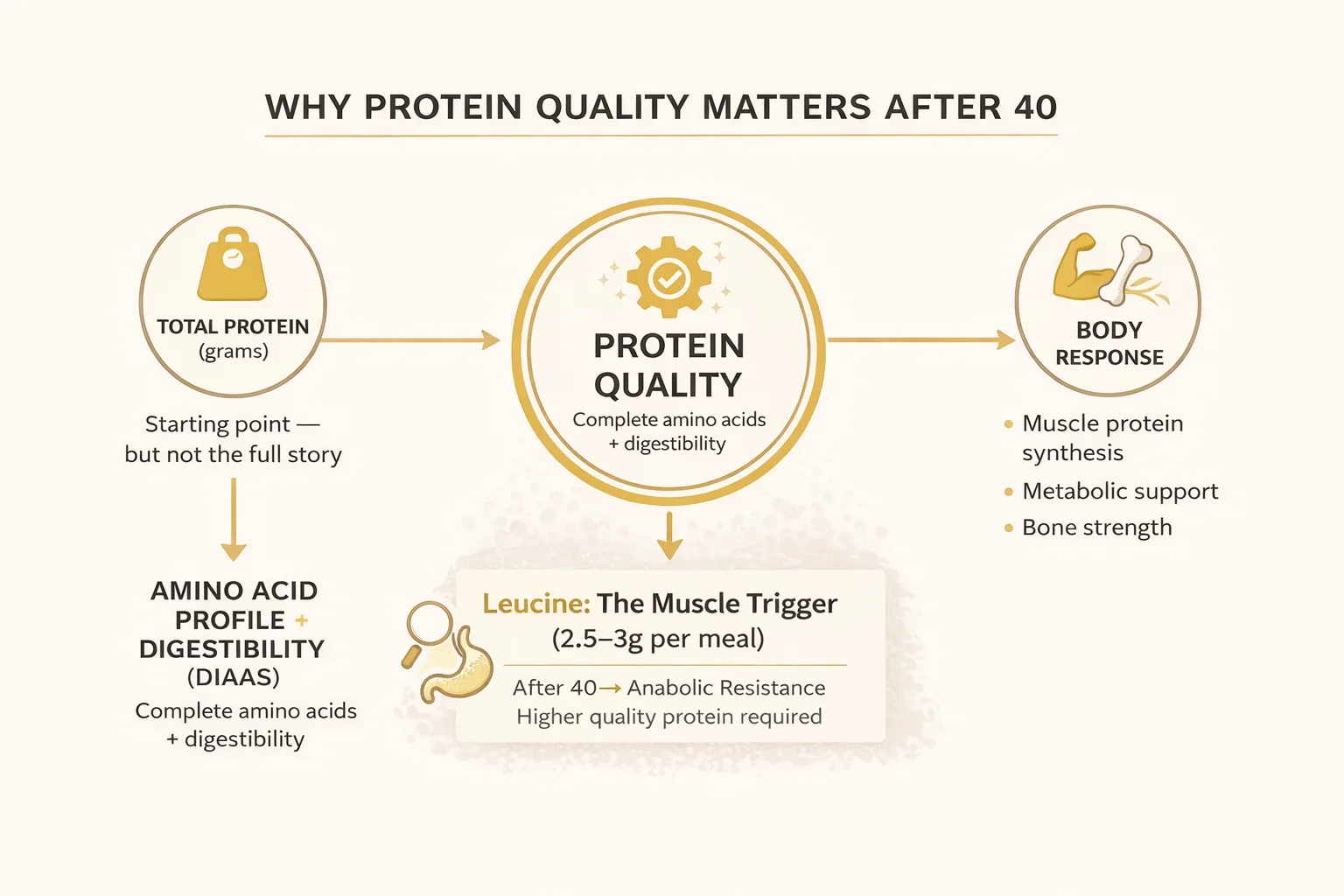
The big takeaway here is that fixating only on the total grams of protein you eat misses half the story. The usability of that protein is what truly matters for your strength and health.
How Scientists Measure Protein Quality
To make sense of all this, scientists developed scoring systems to grade different protein sources. The original score, PDCAAS, was a huge step forward. You can think of it like an old, standard-definition photograph—it gave us a decent picture, but a lot of the finer details were a bit fuzzy.
The new gold standard is a much more sophisticated system called the Digestible Indispensable Amino Acid Score (DIAAS). This is our high-definition 4K photo. It gives us a crystal-clear, accurate view of how well your body can not only digest a protein but also absorb and use each of those essential amino acid "bricks."
In 2013, the Food and Agriculture Organization (FAO) officially recommended moving to DIAAS because it measures amino acid absorption where it actually happens—at the end of the small intestine. It’s a more precise, real-world measurement of a protein’s value to the body.
Here's a quick look at how the two systems compare.
A Quick Guide to Protein Quality Scores
This simple table breaks down the key differences between the old and new methods for scoring protein. You don't need to memorize the scores, but they help show why some protein sources are more effective than others.
PDCAAS vs DIAAS (Protein Quality Scoring Systems)
PDCAAS is the original protein quality score. DIAAS is the newer method that measures how well essential amino acids are absorbed, providing a more precise view of protein quality.
| Feature | PDCAAS (The Original Score) | DIAAS (The Modern Standard) |
|---|---|---|
| What it measures | How well a protein provides all 9 essential amino acids after digestion. | How well each individual essential amino acid is absorbed by the body. |
| How it’s measured | Based on amino acid absorption from the entire digestive tract. | Measures absorption specifically in the small intestine, which is more accurate. |
| Score cap | Capped at 1.0 (or 100%). It can’t show if a protein is better than perfect. | Can go above 1.0, allowing us to see which proteins are exceptionally high quality. |
| Example scores | Soy protein isolate and beef both score a perfect 1.0. | Whey protein can score 1.09, eggs 1.13, and milk 1.14, while lentils score 0.65. |
These scores reveal an important pattern: animal proteins and certain dairy and soy products are often more "bioavailable," but combining different plant sources is a powerful strategy to build a complete amino acid profile.
The Most Important Amino Acid For Muscle Health
Drilling down one level deeper, there’s one specific amino acid that acts as the master switch for muscle health, especially for women over 40: leucine.
Think of leucine as the ignition key for muscle protein synthesis. It's the primary trigger that tells your muscles, "Okay, it's time to repair and rebuild!" After workouts or just the normal wear-and-tear of daily life, leucine is what kicks off the recovery process.
Research shows that as we age, our muscles become a bit "deaf" to this signal. We need a stronger leucine signal—a higher dose per meal—to get the same muscle-building response we did in our 20s and 30s.
To dive deeper into how this works and why it’s so critical in midlife, you can explore the science behind protein needs after 40.
Getting a handle on these concepts—essential amino acids, digestibility scores, and the crucial role of leucine—is the first step toward making protein work harder for you. It’s not about food rules; it’s about understanding your body better.
Why Protein Quality Is Your Ally After 40
This is where the science becomes personal. For many women navigating perimenopause and beyond, our bodies go through a quiet but powerful shift. This is the stage of life where anabolic resistance can become a factor.
Think of it this way: our muscles become a bit "hard of hearing." The signals from protein that tell them to grow and repair just don't come through as clearly as they used to. That means we need a stronger, clearer signal—which comes directly from higher-quality protein—to get the same muscle-building response we once did.
Making protein quality a priority isn't about adding another complicated rule to your life. It’s a powerful way to work with your body during this transition, not against it.
The Midlife Muscle and Metabolism Connection
Lean muscle is your metabolic engine. It’s the tissue that burns calories most efficiently, even when you're at rest. But as our bodies become less responsive to protein, holding onto that muscle gets tougher, which can directly impact your metabolism and body composition.
Focusing on high-quality protein gives your muscles the direct, potent stimulus they need to stay strong. This isn't about becoming a bodybuilder. It's about preserving the very engine that keeps your metabolism humming and gives you the strength for everything you want to do.
It's a common myth that you need extreme diets or grueling workouts to manage midlife body changes. The truth is, a gentle shift toward better-quality protein at each meal can make a huge difference in supporting your metabolic health, without stress and restriction.
Supporting Bone Density and Satiety
The benefits don't stop at your muscles. Your bones are also built on a protein matrix, and giving them a steady supply of high-quality amino acids is essential for keeping them dense and resilient.
Plus, high-quality protein has a powerful effect on satiety—that feeling of being full and satisfied after you eat. This helps you manage your appetite naturally, giving you a tool for weight management that doesn’t depend on willpower alone.
Here’s what a focus on protein quality really helps you do:
Maintain Lean Muscle: It directly works against age-related muscle loss, helping you protect your metabolic engine.
Support Strong Bones: It delivers the essential building blocks for a dense bone matrix, a top concern for women over 40.
Promote Natural Satiety: It keeps you feeling fuller for longer, making it easier to manage your energy intake without feeling deprived.
These age-related shifts are a normal part of life. Leaning into protein quality is one of the most effective and gentle ways you can support your body through it all. If you're concerned about age-related muscle loss, you can read our guide on sarcopenia for more information. This strategy is all about building resilience from the inside out.
Your High-Quality Protein Toolkit
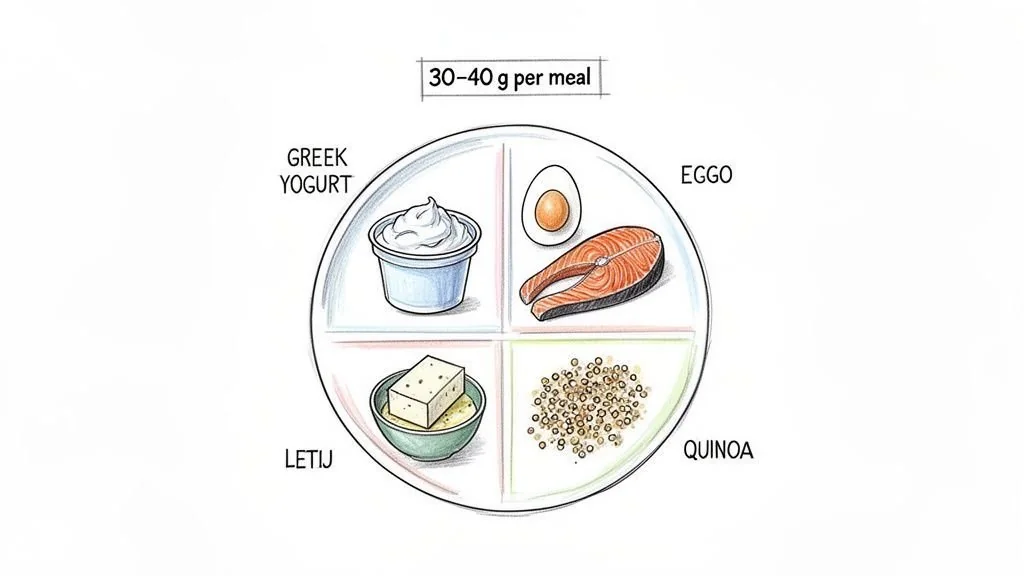
Okay, the science part is interesting, but what really matters is getting this knowledge onto your plate. The goal isn't complicated food rules—it's about making smart, simple choices that feel sustainable.
This is your practical guide. It’s about stocking your kitchen with powerhouse ingredients that work hard for your health, one meal at a time.
Top-Tier Protein Sources
Let’s build a go-to list of foods that deliver the best bang for your buck. These are considered high-quality because they’re packed with all the essential amino acids—especially that muscle-triggering leucine—and your body can easily digest and use them.
Animal-Based Powerhouses:
Greek Yogurt: A creamy, versatile staple. Look for plain varieties to avoid added sugars.
Eggs: Often called nature's multivitamin for a reason. They're an affordable and incredibly easy complete protein source.
Salmon & Fatty Fish: You get a wonderful two-for-one here: high-quality protein plus anti-inflammatory omega-3 fatty acids.
Lean Poultry: Chicken and turkey breast are fantastic, low-fat sources of complete protein that you can build almost any meal around.
Plant-Based Champions:
Tofu & Tempeh: As complete proteins, these soy-based foods are a phenomenal foundation for any plant-forward meal.
Lentils: An absolute workhorse. They’re loaded with protein and fiber, and they soak up flavor beautifully.
Quinoa: This one is special. Unlike most other grains, quinoa is a complete protein, meaning it has all nine essential amino acids.
Hitting Your Per-Meal Protein Target
For many women after 40, one of the most powerful nutritional strategies is focusing on the per-meal protein threshold. To send a strong enough signal to your muscles, research shows that aiming for 30-40 grams of high-quality protein at each main meal is a highly effective way to trigger muscle repair and growth.
Think of it this way: hitting a 30-gram target at each meal sends a strong, clear signal to your muscles to rebuild. It’s like turning up the volume so your muscles can finally "hear" the message to stay strong.
This doesn't have to be a math puzzle. The table below gives you a few simple, real-world examples of how to reach that target with whole foods.
Meeting Your Per-Meal Protein Target
Examples of simple food combinations that help you reach the 30–40g protein threshold per meal for optimal muscle support.
| Food Source (Approximate Portions) | Estimated Protein (grams) | Quality Notes |
|---|---|---|
| Greek Yogurt Bowl | ~32g | 1 cup plain Greek yogurt (22g) + 2 tbsp hemp seeds (6g) + 1 oz almonds (6g) |
| Chicken Salad | ~35g | 4 oz grilled chicken breast (31g) on a bed of greens with seeds (4g) |
| Salmon & Quinoa | ~32g | 4 oz baked salmon (23g) + 1 cup cooked quinoa (8g) + broccoli |
| Tofu Scramble | ~30g | 1 cup firm tofu (20g) + 1/2 cup black beans (8g) + nutritional yeast (2g) |
As you can see, a little thoughtful combining makes hitting your target much easier than you might think.
The Power of Protein Combining
If you eat a plant-forward diet, this is where understanding protein quality becomes a superpower. While many plant foods are incredible, most are low in one or two essential amino acids. But there's an easy fix.
The simple strategy of protein combining ensures you get all the amino acid "bricks" your body needs. You don't even have to do it in the exact same meal, but it’s often easiest to think of it that way.
You already know the classics:
Beans and Rice: A staple in countless cultures for a reason—together, they create a complete protein.
Hummus and Whole-Wheat Pita: Legumes (chickpeas) and grains (wheat) perfectly complement each other's amino acid profiles.
Peanut Butter on Whole-Grain Toast: Another easy, effective pairing that gives you the full set of aminos.
Building meals this way is a gentle way to ensure your body gets everything it needs to thrive. For anyone wanting to dig deeper, our guide on vegan protein sources offers even more tips and meal-building strategies.
Tracking Quality, Not Just Quantity (coming soon)
Putting protein quality into practice can feel like one more thing to manage. That’s exactly why we’re building Just Protein — a simpler way to understand not only how much protein you’re eating, but how usable it is for muscle support after 40.
What Just Protein is being built to show you
Your meal’s amino acid profile (not just grams)
Whether you hit a leucine “muscle trigger” target
Simple swaps and pairings to improve protein quality (especially for plant-forward meals)
✅ Just Protein is accepting waitlist! Waitlist members will get early access plus more when we launch.
Personalized Guidance for Your Goals
This is the kind of detailed feedback where real, lasting change happens. It empowers you to see how small tweaks—like adding a handful of pumpkin seeds to your yogurt or pairing your beans with rice—can dramatically improve the quality score of your meal.
Technology can act as a supportive partner on your health journey. It’s not about judgment or perfectionism; it's about providing clear, actionable information that empowers you to build strength and resilience with confidence, one meal at a time.
This approach gives you personalized feedback that works whether you're an omnivore or fully plant-based, helping you build habits that actually stick. A smart system can suggest simple food pairings to make sure your meals are working as hard as you are.
A great starting point is to get a baseline for your own needs. Using a tool like a protein intake calculator can help you set a personalized target to aim for.
Common Questions About Protein Quality
Once you start focusing on the quality of your protein, not just the grams, a few questions often come up. Let’s tackle the most common ones with clear, science-backed answers.
Myth: Will eating more high-quality protein make me bulky?
Reality: This is probably the biggest myth holding women back. Building significant muscle "bulk" is incredibly difficult for women from a biological standpoint. It requires a very specific, intense training and nutrition regimen that you won't accidentally stumble into.
For women over 40, prioritizing high-quality protein is about supporting lean muscle maintenance. This is what leads to a stronger, more toned physique and a supported metabolism—not bulkiness.
Myth: Are protein shakes necessary to meet my goals?
Reality: Absolutely not. You can easily meet all your protein needs with whole foods like Greek yogurt, eggs, chicken, fish, and tofu.
Protein shakes are a tool for convenience. They can be helpful on busy days or after a workout when you need a quick, easily digestible source of high-quality protein. The most important thing is consistently hitting your protein target for each meal, whether it comes from a shaker bottle or a dinner plate.
Myth: Do I need to eat a lot more food on a plant-based diet to get enough protein?
Reality: Not necessarily more food, but a bit more strategy. Because many plant proteins are lower in one or more essential amino acids, the key is protein combining.
Think of it like building with two different Lego sets—one has all the blue bricks, the other has all the red. You need both to finish the project. Pairing sources like grains with legumes (the classic rice and beans) is a perfect example of creating a complete amino acid profile. It’s all about smart combinations, not just bigger portions.
Myth: Is protein only important for muscles?
Reality: Protein's role in bone health is often overlooked. Our bones are living tissues built on a protein matrix, which is mostly made of collagen. High-quality protein delivers the essential amino acid building blocks needed to constantly repair and strengthen that matrix.
Research shows that getting enough quality protein, right alongside minerals like calcium, is a non-negotiable for maintaining bone density. This is one of your best defenses against osteoporosis and fractures, a major concern for women as we navigate perimenopause and beyond. For more on this, our FAQ page has answers to other common questions.
Ready to stop guessing and start seeing what your protein is really doing for you? Just Protein is the only app designed to analyze the quality of your meals, not just the quantity. Sign up for the waitlist today and get ready to fuel your strength from the inside out: https://justprotein.app
This article is for education only and is not medical advice. Just Protein is not a medical provider — we summarize published research and cite our sources so you can verify them; decisions about your health, hormones, or mood belong with your doctor.